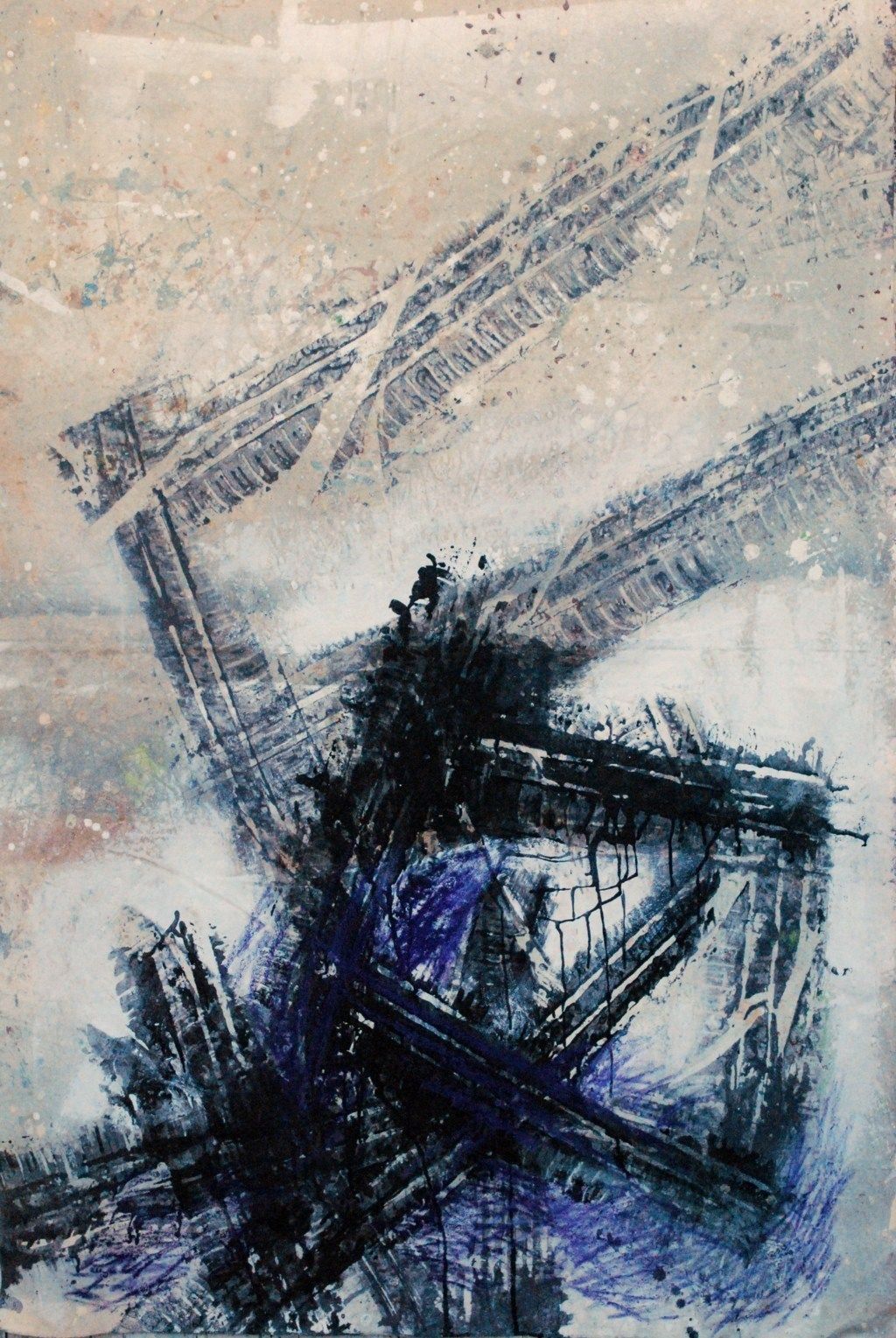
Tracce pneumatiche, 2015. (Cover di Nijinsky,1950). Acrilico su tela Satin, 105x165.
1 owner
Base
## THE SILENT TRACK
Pneumatic traces originate, in a somewhat paradoxical way, from the noisy, clamorous side of modernity: motor vehicles, together with the entire mythical constellation whose shadows extend into the present — speed, progress, dynamism.
In our imagination, these traces certainly evoke modernity, but as simple images they resemble more closely remains, residues, silent relics which, once verbal communication has been suspended, give rise to a different kind of communication. Here, too, the affinities with the Abstract Expressionist horizon are evident: those artists moved within a pre-linguistic universe of emotions and perceptions, standing in opposition to verbal language, which political regimes were bending to propagandistic and/or celebratory ends, and within which the foundations were being laid for what would become the stereotyped, conformist society of spectacle and advertising.
This essential, simplified language is the product of the mechanical movement of the vehicle as it leaves its impression on the canvas. Of course, there is always a driver guiding it, but its trajectories are only partly determined by the driver, because the vehicle possesses a form of autonomy different from that of the brush, and presupposes a different kind of training and practice.