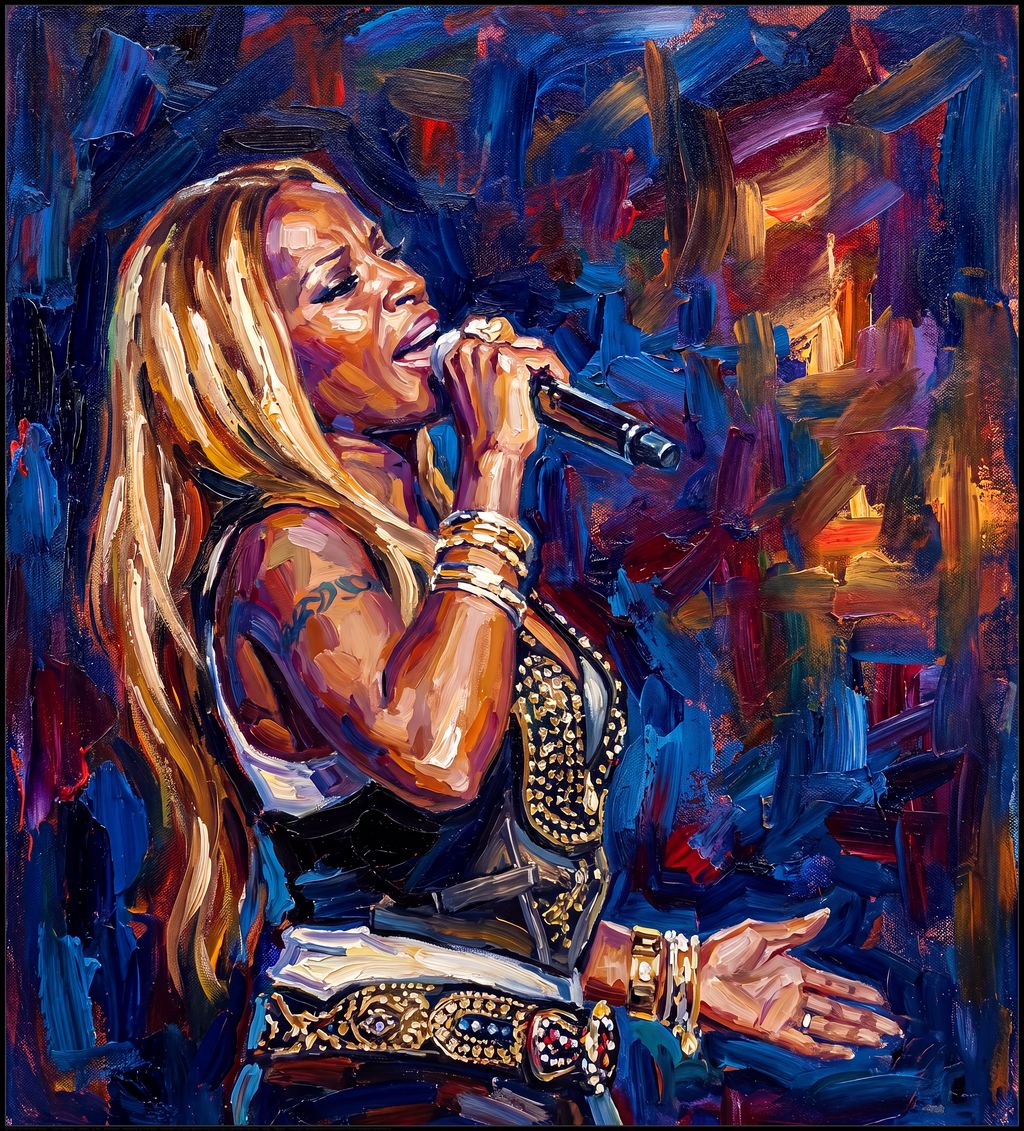
QUEEN OF HIP-HOP SOUL
Mary J. Blige - The Crown Was Forged, Not Given
Before the crown, there was a girl from the Bronx, raised in Yonkers, with a voice too big for the circumstances surrounding her.
Before the platinum records, the Grammys, the sold-out arenas, and the Rock & Roll Hall of Fame, there was a young woman singing Anita Baker into a recording booth at a shopping mall.
A homemade cassette. An unlikely opening.
Jeff Redd helped carry that voice toward Uptown Records. Andre Harrell heard something worth betting on. The machinery of the music business opened its doors.
But the machinery didn't invent Mary J. Blige.
She arrived carrying the church, the street, the heartbreak, the attitude, and a voice that refused to separate any of them.
THE SOUND OF A NEW KINGDOM
1992. What's the 411?
Hip-hop had the beats. R&B had the melodies. Gospel had the fire.
Mary brought them into the same room and knocked down the walls.
"You Remind Me" announced her arrival. "Real Love" turned the announcement into a cultural earthquake.
The rhythm came from the street. The voice came from somewhere deeper. The baseball caps, boots, oversized jackets, and unapologetic swagger weren't costumes borrowed from the boys.
They were her language.
Here was a woman who didn't need to dress like yesterday's polished R&B princess or sing like somebody else's idea of perfection.
She could be vulnerable and dangerous in the same breath.
Hip-hop soul wasn't invented from nothing. Musical traditions had been crossing boundaries for generations. But Mary made this particular collision a defining sound of the 1990s.
The Queen of Hip-Hop Soul had arrived.
MY LIFE - NO ARMOR LEFT
1994.
If What's the 411? built the kingdom, My Life opened the queen's private diary.
"I'm Goin' Down." "Be Happy." "Mary Jane (All Night Long)." "My Life."
The songs weren't polished escape routes from suffering. They were windows into it.
Love could wound. Success could coexist with despair. A woman could be celebrated by millions and still be fighting to survive herself.
Mary sang with the kind of emotional exposure that popular music often asks women to conceal.
No perfect heroine.
No immaculate fairy tale.
No pretending the crown made the pain disappear.
And something extraordinary happened.
Millions recognized themselves.
The music became more than entertainment. It became company for people navigating heartbreak, addiction, loneliness, and the long, uneven road toward self-respect.
Mary didn't sing from above the struggle.
She sang from inside it.
THE QUEENS WERE BUILDING SOMETHING
Mary wasn't standing alone.
Queen Latifah had already demanded respect and authority. MC Sha-Rock and Roxanne Shante had helped establish women's place at the microphone. Lil' Kim and Foxy Brown would sharpen persona into armor. Da Brat kicked open a platinum door. Missy Elliott bent the future into new shapes.
Lauryn Hill brought lyrical intellect and extraordinary emotional range. Faith Evans, Aaliyah, TLC, SWV, Erykah Badu, and Jill Scott expanded the possibilities of soul, rhythm, identity, and womanhood.
Different instruments. Different battles. Different crowns.
Mary's territory was the exposed human heart.
She made pain audible without making weakness its definition.
THE HITS KEPT COMING
1995. Method Man.
"I'll Be There for You/You're All I Need to Get By" welded Wu-Tang grit to Mary's soulful warmth.
A hip-hop love anthem became a Grammy-winning landmark.
1996. "Not Gon' Cry."
Babyface's sweeping ballad for Waiting to Exhale carried Mary's heartbreak into the pop mainstream.
1997. Share My World.
Her first Billboard 200 No. 1 album. "Everything." "I Can Love You." A woman who once sang into a mall recording booth now commanded the industry's biggest stage.
2001. No More Drama.
"Family Affair," produced by Dr. Dre, climbed to No. 1 on the Billboard Hot 100.
But the title track carried another declaration.
Enough pain.
Enough chaos.
Enough surrendering her life to the damage.
The queen was no longer merely documenting the storm.
She was trying to walk out of it.
THE BREAKTHROUGH
2005.
"Be Without You" became one of the defining R&B records of its era, holding the top of Billboard's Hot R&B/Hip-Hop Songs chart for 15 weeks.
The Breakthrough earned eight Grammy nominations. At the 2007 ceremony, Mary took home three awards, including Best R&B Album.
This wasn't nostalgia for a 1990s pioneer.
This was a working artist still conquering the present.
Then came Growing Pains in 2007.
"Just Fine" and "Work That" carried a different electricity: self-acceptance, confidence, and the possibility that happiness could be as powerful as sorrow.
The woman who had made heartbreak an art form was learning to celebrate survival.
THE CROWN BECOMES HISTORY
Nine Grammy Awards.
A 2019 BET Lifetime Achievement Award.
The 2022 Billboard Icon Award.
A commanding place in the 2022 Super Bowl halftime celebration alongside Dr. Dre, Snoop Dogg, Eminem, and Kendrick Lamar.
And in 2024, induction into the Rock & Roll Hall of Fame.
Method Man and Dr. Dre helped welcome her into an institution that had finally caught up with what generations of listeners already understood.
Her music belonged to the architecture of American popular culture.
But the most important evidence was never a trophy.
It was the women who heard permission in her voice.
Beyonce. Alicia Keys. Rihanna. SZA. H.E.R. And countless others who inherited a world where an R&B singer could be raw, streetwise, wounded, furious, sensual, spiritual, and triumphant without asking anyone to reconcile the contradictions.
Mary helped make that freedom possible.
THE QUEEN OF HIP-HOP SOUL
The crown was never about being the first woman to sing over a breakbeat.
It was about transforming a musical intersection into a home.
She brought gospel into hip-hop's engine room. She brought the street into soul's sanctuary. She gave heartbreak a microphone and refused to lower the volume.
The albums changed.
The fashion changed.
The industry changed.
The woman changed.
But that voice kept returning with the same essential promise:
You can survive what tried to silence you.
Mary J. Blige didn't simply rise from the struggle.
She made the struggle sing.
And somewhere between "Real Love" and "No More Drama," between "My Life" and "Just Fine," the crown stopped being a nickname.
It became a piece of music history.
Long live the Queen.