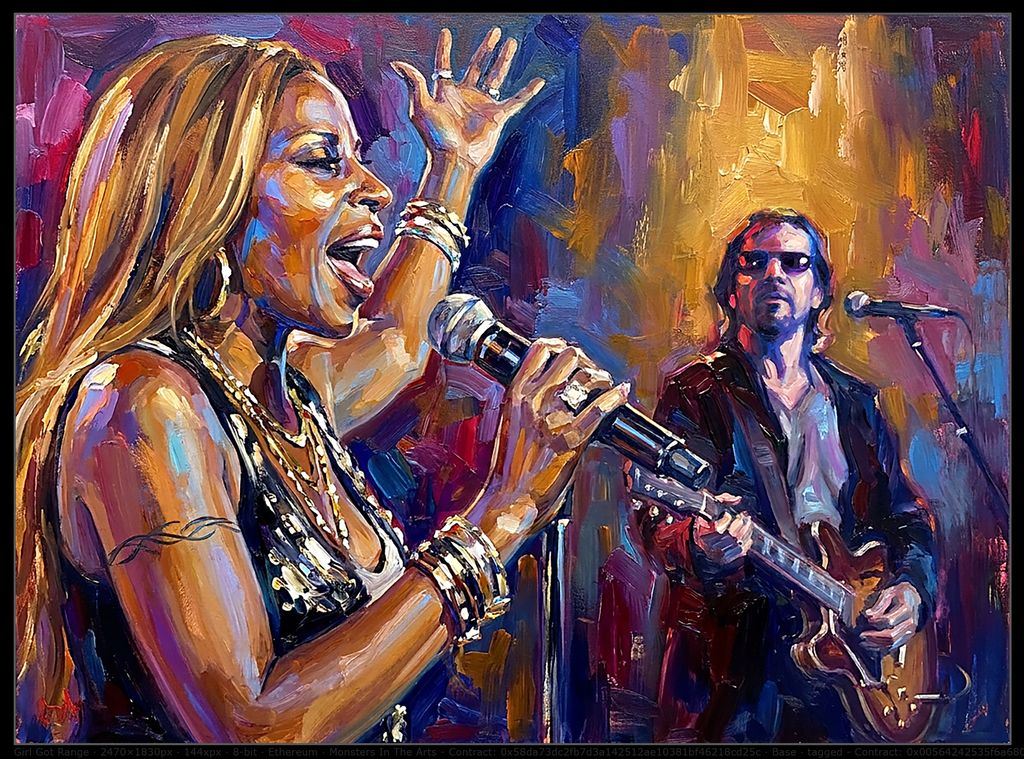
Girl Got Range
Mary J. Blige - One Voice, No Borders
They crowned her the Queen of Hip-Hop Soul. She earned it. But a crown can become a cage if the world mistakes your kingdom for the limits of your voice.
Mary J. Blige was never limited to one kingdom.
The Yonkers-born singer brought church-rooted soul into the hard machinery of hip-hop, turning heartbreak, survival, and street-level honesty into a new musical language. She could ride a breakbeat like a confession, then rise above an orchestra like a cathedral opening its doors.
Whitney Houston, the great queen of pop-soul vocal majesty, had shown the world what extraordinary vocal power could do. Mary possessed that kind of reach, too. But rather than polish away her scars, she made them part of the instrument.
Two performances of one song reveal just how far that instrument could travel.
ONE - U2 / MARY J. BLIGE
Written by U2 and released in 1992, "One" was already a monumental rock anthem: a plea for connection that refused to pretend connection was easy.
In September 2005, Mary joined Bono, The Edge, Adam Clayton, and Larry Mullen Jr. for a Hurricane Katrina relief performance. Rock met hip-hop soul, but neither side had to surrender its identity.
Bono brought the song's familiar ache. Mary brought another kind of weather.
Her voice climbed through the arrangement with gospel fire, rough-edged tenderness, and the authority of someone who had lived the words rather than simply learned them.
The collaboration entered her 2005 album The Breakthrough and became an international single in 2006. Its black-and-white music video placed two musical worlds in the same frame.
Not a guest appearance. Not a novelty duet.
Two traditions discovering they could speak the same language.
ONE - OSLO, 2013
December 11, 2013. Oslo, Norway.
Nelson Mandela had died six days earlier. At the Nobel Peace Prize Concert, Mary performed "One" in his memory.
The song had traveled again.
What began as a rock band's meditation on fractured relationships became a public expression of mourning, solidarity, and the difficult work of human unity.
No Bono beside her. No need to borrow the authority of a legendary rock band.
Mary stood before the microphone and carried the song herself.
Her delivery moved between restraint and eruption, tenderness and thunder. A voice born in gospel, sharpened by hip-hop, and seasoned by decades of emotional combat reached across genre, geography, and generations.
The occasion gave every word another weight.
Mandela's legacy was not the fantasy that humanity had become one. It was the insistence that people divided by history could still struggle toward one another.
And Mary sang into that unfinished promise.
TWO STAGES. ONE VOICE.
2005-2006: A queen of hip-hop soul crosses into the architecture of arena rock.
2013: That same voice carries a rock anthem into an international remembrance of a man who helped change the moral geography of the twentieth century.
The distance between those performances is not measured in miles.
It is measured in meaning.
Mary J. Blige could have pursued a different musical road. The power, range, and gospel foundation were always there. Instead, she helped invent a road of her own, then proved she could travel beyond it whenever the music demanded.
The crown was never the ceiling.
The voice was always bigger than the kingdom.