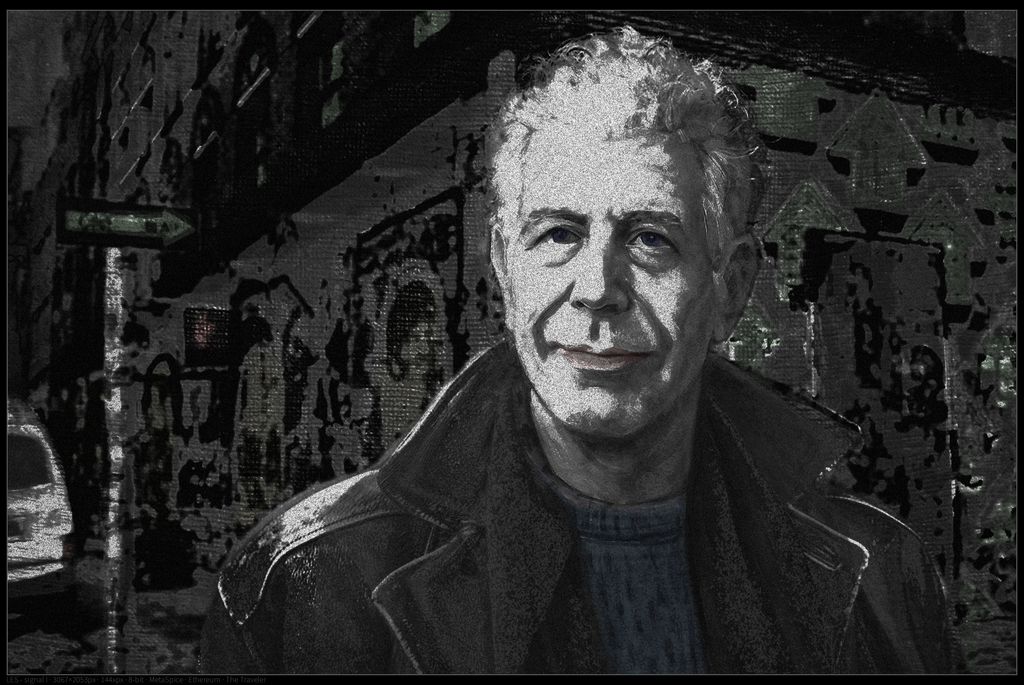
Retirement City for Beautiful Burnouts
Anthony Bourdain: Parts Unknown is really about survivors.
Not clean heroes.
Survivors.
People who somehow made it through decades of noise, chemicals, ego, bad decisions, touring, nightlife, reinvention, fame, loneliness, and American appetite culture —
and woke up old enough to look back at the wreckage thoughtfully.
That’s why Iggy Pop is not just a guest in this episode.
He’s emotional infrastructure.
Bourdain adored him. Openly. Almost boyishly.
Not because Iggy was “punk rock cool.”
Because Iggy survived becoming Iggy Pop.
That’s a completely different achievement.
By the time this episode airs, both men are older.
Calmer on the surface.
Still carrying visible traces of former combustion.
And Miami becomes the perfect backdrop for that stage of life:
a city where beautiful burnouts wash ashore under palm trees pretending they’re finally going to relax.
The episode moves through Cuban cafeterias, Venezuelan migration zones, Black Miami music history, gas station food, late-night drift energy —
but the real gravity keeps pulling back toward the Bourdain/Iggy conversations.
Because they’re not performing celebrity interview theater.
They’re comparing survival notes.
You can feel Bourdain trying to understand something about aging from a man who by all logic should have self-destructed decades earlier.
And Iggy, at this stage of life, lands somewhere surprisingly gentle.
Reflective.
Grounded.
Almost peaceful.
One of the emotional centerlines of the episode is Iggy essentially arriving at an old-man conclusion that sounds absurdly simple after a lifetime of chaos:
being loved is the most important thing.
Not fame.
Not coolness.
Not mythology.
Not excess.
Not applause.
Love.
That realization hangs over the episode like humid Miami air.
Especially watching it after Anthony Bourdain dies.
Because Bourdain still seems restless beside him.
Still moving internally.
Still searching for stable gravity while interviewing someone who may have accidentally found a version of it already.
And the music lineage underneath the episode matters too.
Iggy isn’t just “punk icon.”
He’s connective tissue across entire generations of outsider music culture:
The Stooges →
proto-punk →
punk →
post-punk →
alternative →
grunge →
industrial →
garage revival →
basically half the angry beautiful noise of the next fifty years.
Six degrees from Iggy reaches almost everybody:
David Bowie in Berlin exile survival mode,
MC5 Detroit revolutionary noise,
Sex Pistols,
Nirvana,
Queens of the Stone Age,
even Bourdain-world itself through recurring musician friendships and outsider worship.
Bourdain always trusted musicians more than polished celebrity types anyway.
Especially the damaged poets.
The noise merchants.
The people who turned alienation into art form.
Iggy was patron saint of that entire ecosystem.
And Miami itself mirrors the emotional logic perfectly:
half paradise,
half exhaustion,
half reinvention fantasy,
half spiritual waiting room for people who already lived several lives elsewhere.
Bourdain even frames the city like that:
people sneaking up on Miami accidentally after years of saying they’d never become “that person.”
Which is why the final beach scenes land so hard.
Two older men.
Ocean behind them.
The chaos mostly survived.
Bodies still functioning somehow.
Talking quietly instead of exploding.
No giant revelation.
No dramatic ending.
Just the strange realization that after decades spent chasing appetite, rebellion, danger, and motion —
maybe the whole game narrows eventually to:
who loves you,
who stayed,
and whether you learned how to stay back.
—
Breadcrumbs
• Iggy Pop appeared prominently in the Miami episode and discussed curiosity, aging, survival, and contentment with Bourdain.
• Bourdain described himself as unusually star-struck meeting Iggy Pop, whom he viewed as a personal hero.
• The Stooges helped lay groundwork for punk, post-punk, grunge, and alternative rock movements.
• Iggy Pop’s long artistic relationships included major collaborations with David Bowie during the Berlin years.
• Bourdain consistently gravitated toward musicians and artists who survived self-destructive cultural eras while retaining authenticity.
• Miami is framed in the episode as both tropical paradise and psychological landing zone for people reinventing themselves after previous lives collapse or mutate.
—
Anthony Bourdain, Parts Unknown, season 5, episode 2, “Miami,” aired May 3, 2015, on CNN.
Anthony Bourdain, “Raw Power,” Medium, April 29, 2015.
“The Survival of Iggy Pop,” The New Yorker, August 26, 2019.