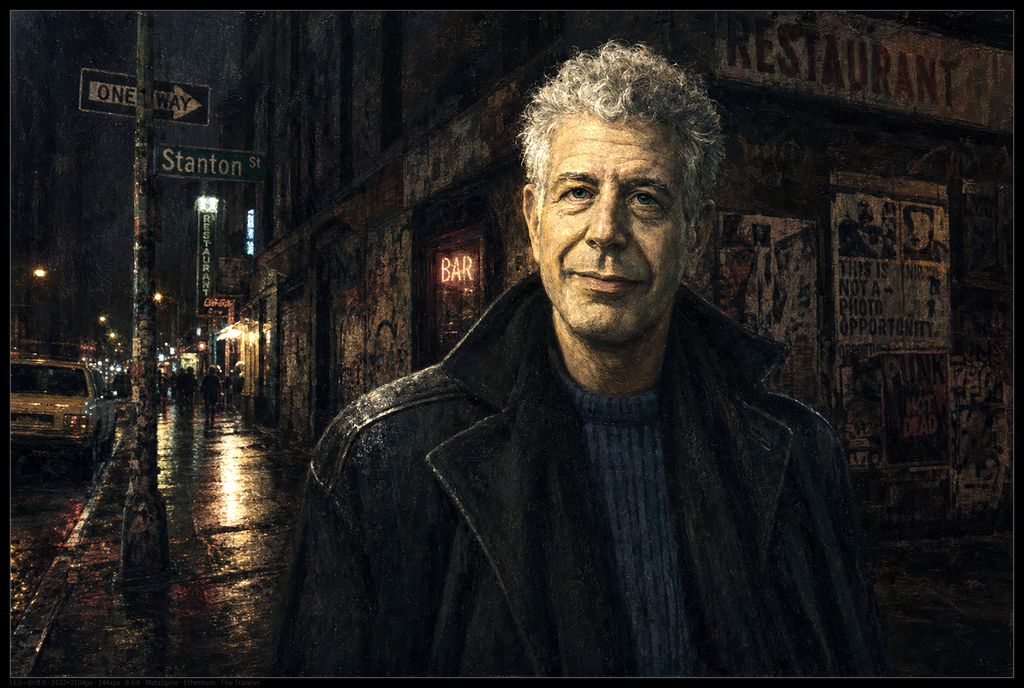
Bottom of the World — Motherfuckers
Anthony Bourdain: Parts Unknown feels like the universe testing whether human beings can romanticize discomfort indefinitely.
Turns out:
absolutely yes.
Because Antarctica is basically:
months of logistics,
violent seas,
frozen wind punishment,
industrial-strength isolation,
sleep deprivation,
gray military-food energy,
and existential exhaustion —
all for occasional moments where someone quietly says:
“Wow.”
Then immediately loses feeling in their face again.
Bourdain understands the absurdity instantly.
Good.
Because the mythology surrounding Antarctica is enormous:
last frontier,
pure wilderness,
heroic endurance,
edge-of-human-existence grandeur.
And sure —
the place is visually staggering.
Ice that looks prehistoric.
Silence so complete it feels synthetic.
Landscapes stripped down to geology and weather.
But the episode wisely refuses to become motivational-poster pornography.
Instead it keeps drifting back toward a more honest realization:
This place does not care about you at all.
That’s part of the attraction.
Modern life increasingly insulates people from consequence:
temperature-controlled rooms,
instant food,
algorithmic entertainment,
GPS certainty,
constant stimulation.
Antarctica removes all of that.
Suddenly existence becomes primitive again:
stay warm,
don’t fall,
don’t drift,
don’t lose focus,
keep moving.
The human ego shrinks appropriately.
Bourdain always respected places capable of shrinking ego.
Especially places immune to branding culture.
No artisanal authenticity theater here.
No influencer energy.
No “hidden gem” café recommendations.
Just ice, machinery, survival systems, and people doing difficult repetitive work very far from home.
That labor element matters.
Because beneath the cinematic beauty sits an industrial reality:
research stations,
supply chains,
maintenance crews,
ships,
fuel,
engineering,
international politics disguised as scientific cooperation.
Even the end of the Earth requires infrastructure.
And then the deeper Bourdain theme emerges:
the long journey with uncertain emotional payoff.
Travel culture constantly sells transcendence.
Go far enough and you’ll become transformed.
Find yourself.
Heal yourself.
Discover meaning at the horizon.
Antarctica quietly laughs at that fantasy.
Sometimes you travel across the planet,
freeze your ass off,
survive rough seas,
stare into infinite white silence —
and the reward is mostly:
fatigue.
Maybe a photograph.
Maybe perspective for twenty minutes before ordinary anxiety returns.
Bourdain understood that too.
He spent years professionally chasing “the moment” across continents:
the perfect meal,
the perfect conversation,
the perfect revelation.
But the older he got, the more the show started revealing another truth:
movement itself can become addiction.
Not enlightenment.
Motion.
Keep going.
Next airport.
Next country.
Next table.
Next temporary meaning injection.
Antarctica pushes that logic to absurd completion:
you literally reach the bottom of the world —
and still bring yourself with you.
That’s the joke underneath the episode.
And Bourdain seems fully aware of it.
Which is why the tone lands somewhere between awe and cosmic sarcasm.
Yes, the place is magnificent.
Yes, human beings are tiny.
Yes, there’s beauty in the suffering.
But also:
this is an unbelievably long, expensive, physically miserable journey for a payoff that mostly consists of saying,
“Holy shit, it’s cold.”
And somehow that honesty makes the episode stronger.
No fake enlightenment.
No TED Talk spirituality.
No clean emotional resolution.
Just humans wandering to the edge of existence because wandering itself became part of the species software.
Bottom of the world.
Motherfuckers.
—
Breadcrumbs
• Antarctica is the coldest, driest, and windiest continent on Earth.
• Antarctic travel requires major logistical coordination involving research stations, ships, aviation support, and international treaties.
• The Antarctic Treaty System regulates scientific cooperation and territorial activity on the continent.
• Bourdain frequently explored the gap between romanticized travel mythology and the exhausting physical realities of constant movement.
• Many later Parts Unknown episodes carry increasing undertones of fatigue, alienation, and existential drift beneath the visual spectacle.
• Antarctica occupies a unique symbolic role in modern imagination: purity, isolation, apocalypse, scientific frontier, and planetary fragility all projected onto one landscape.
—
Anthony Bourdain, Parts Unknown, season 9, episode 5, “Antarctica,” aired June 4, 2017, on CNN.
Sara Wheeler, Terra Incognita (New York: Modern Library, 1997).
Anthony Bourdain, A Cook's Tour (New York: Bloomsbury, 2001).