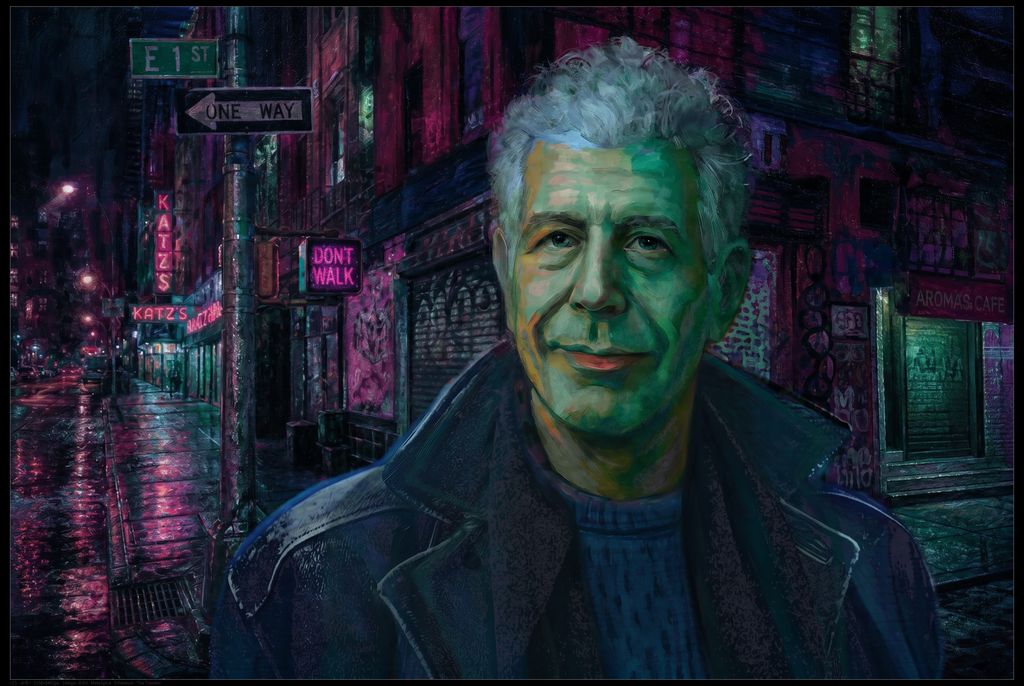
Lower East Side
Anthony Bourdain: Parts Unknown feels like a man walking back through the ruins of the machine that built him.
Not literally.
Spiritually.
Because the Lower East Side wasn’t just another neighborhood to Bourdain.
It was part of the psychic architecture:
punk filth,
cheap apartments,
artist scams,
heroin ghosts,
late-night bars,
kitchen degenerates,
failed musicians,
downtown weirdos,
people living on cigarettes, speed, attitude, and one more bad decision.
Old New York before luxury branding turned “grit” into cocktail-menu typography.
The LES helped create Bourdain’s worldview:
anti-polish,
anti-bullshit,
deeply suspicious of elites,
romantically attached to damaged brilliance.
And by the time he revisits it here —
shortly before his death —
the irony hangs over the entire episode like stale bar smoke:
the outsider kid made it all the way to global cultural institution status…
then returned home just in time to watch the old ecosystem become real-estate content.
The neighborhood itself feels embalmed.
Not dead exactly.
Worse.
Curated.
Luxury apartments standing where artistic chaos once survived accidentally because nobody with serious money wanted the blocks yet.
The Lower East Side became another classic New York cycle:
artists arrive →
weirdness accumulates →
culture gets generated →
money notices →
everything becomes expensive nostalgia for the thing money helped erase.
Bourdain knows the cycle intimately because he himself became part of it.
That self-awareness gives the episode teeth.
And then John Lurie enters.
Perfectly.
Because Lurie belongs to the same endangered downtown species:
part jazz musician,
part actor,
part visual artist,
part surreal anti-celebrity,
part human question mark.
One of those old New York figures who seemed assembled from cigarettes, strange stories, irony, and insomnia.
The kind of artist impossible to manufacture through modern branding pipelines.
And the meal they share becomes one of the funniest quiet flexes in the entire Bourdain universe.
Here sits Anthony Bourdain:
global food icon,
professional eater,
Michelin-adjacent cultural authority,
man who crossed continents chasing transcendent meals.
And John Lurie —
with absolute downtown-artist audacity —
serves him…
a boiled egg.
That’s it.
A boiled egg.
The balls on this guy.
No tasting menu.
No twelve-course performance theater.
No molecular gastronomy smoke tricks.
No “chef’s journey” TED Talk nonsense.
Just:
here’s an egg, Tony.
And Bourdain’s reaction is what makes the scene beautiful.
No ego.
No irony armor.
No performative sophistication.
He basically says:
It’s the perfect meal.
And means it.
Which quietly reveals everything important about Bourdain’s relationship to food by this stage of his life.
After all the airports,
all the luxury meals,
all the “best restaurant in the world” mythology,
all the television spectacle —
what still mattered most was sincerity.
Care.
Presence.
A human being making another human being something simple honestly.
That’s the punchline hidden underneath the sarcasm.
The boiled egg defeats the entire performance economy surrounding modern food culture in under five minutes.
And John Lurie of all people delivers the kill shot.
Perfect.
The episode also carries enormous end-of-life energy retrospectively.
Old friends.
Old neighborhoods.
Old stories.
People who survived scenes that no longer exist.
Everyone looking slightly haunted but still funny.
That’s important:
humor survives longest in these worlds.
Dark humor especially.
Bourdain always trusted people who could joke while discussing collapse.
The LES specialized in that emotional language.
And because this episode aired after Anthony Bourdain died, the entire thing starts feeling like accidental last-call television.
Not dramatic.
Just heavy in hindsight.
A man revisiting the geography that formed him while quietly carrying exhaustion the audience only fully understood later.
Last stop LES.
The train already slowing before anyone on the platform realizes it.
—
Breadcrumbs
• Lower East Side historically housed immigrant communities, punk scenes, avant-garde artists, musicians, and downtown counterculture movements.
• John Lurie is known for The Lounge Lizards, film work, painting, and cult downtown-art-world status.
• Bourdain strongly identified with pre-gentrification New York kitchen and nightlife culture.
• The episode aired posthumously during the final season of Parts Unknown.
• The boiled-egg meal between Lurie and Bourdain became memorable precisely because of its simplicity and anti-performance energy.
• Throughout his career, Bourdain increasingly pushed back against luxury-food spectacle in favor of sincerity, labor, and emotional authenticity.
—
Anthony Bourdain, Parts Unknown, season 12, episode 7, “Lower East Side,” aired November 11, 2018, on CNN.
Luc Sante, Low Life (New York: Farrar, Straus and Giroux, 1991).
John Lurie, The History of Bones (New York: Random House, 2021).