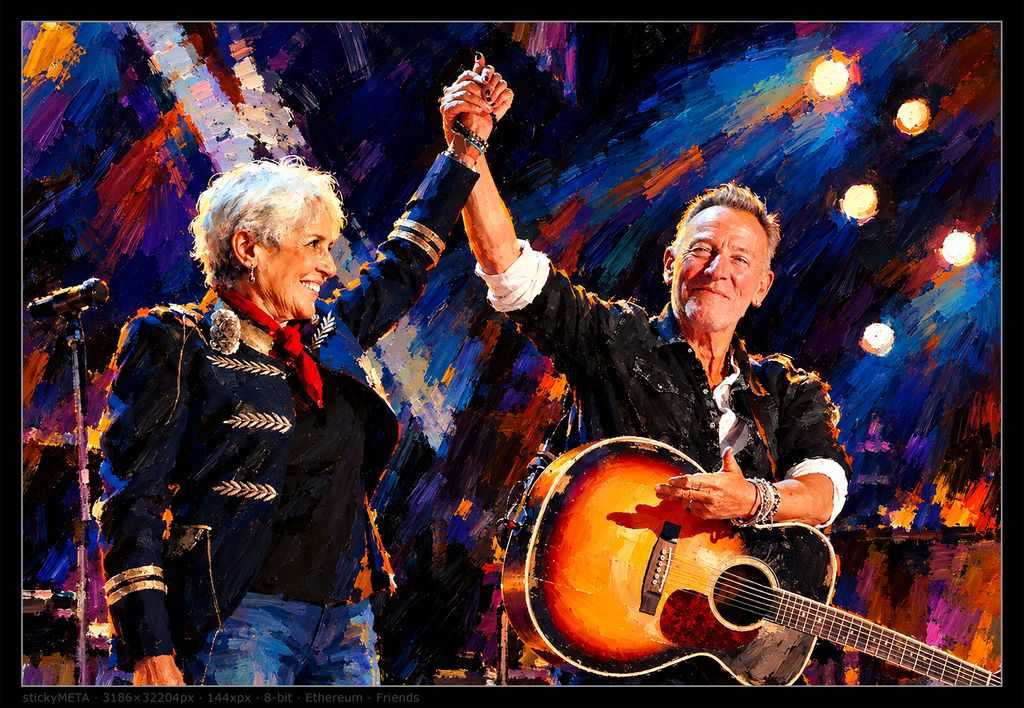
NO TRIBE OWNS RESISTANCE
Put Joan Baez, Public Enemy, Black Sabbath, Cypress Hill, Foo Fighters, Dropkick Murphys, Dave Matthews, Killer Mike, The Linda Lindas, Soundgarden's musical descendants and a bunch of teenagers on the same bill and you should probably get a fucking mess.
October 3, 2026, did.
That was part of the beauty.
Power to the People didn't sound like one political movement.
It sounded like an argument being conducted simultaneously in folk, punk, hip-hop, metal, gospel, soul and rock and roll.
There was no house style.
No approved uniform.
No requirement that resistance arrive with an acoustic guitar.
Although there were plenty of those too.
—
Joan Baez could stand nearly motionless and bring sixty years into the room.
Killer Mike could attack the same broad questions through rap, gospel and the language of voting.
Public Enemy brought sirens, beats, Chuck D's authority and Flavor Flav's chaos.
Black Sabbath arrived through War Pigs.
Dropkick Murphys came swinging through punk, labor and Irish political history.
Cypress Hill could spend a set being Cypress Hill and finish by blowing the roof off with
Jump Around.
Foo Fighters could deliver enormous familiar rock hooks.
Suns of Soundgarden could resurrect the architecture of another band without pretending its missing singer wasn't missing.
The Linda Lindas could remind everybody that punk didn't end when its first generation got old.
Then Tom Morello could throw half the filing system into the garbage.
His Freedom Fighter Orchestra became a concert inside the concert.
Heavy rock.
Rage Against the Machine.
Audioslave.
Then grandson.
Then Serj Tankian.
Then Chuck D and B-Real.
DMC.
Scott Ian.
Sen Dog.
Jack Black.
Flavor Flav.
Dave Grohl.
People walked on.
People walked off.
Songs collided.
“It's Tricky.”
“Walk This Way.”
“Fight the Power.”
“Killing in the Name.”
“Rock and Roll All Nite.”
At some point genre stopped being particularly useful information.
That was the point.
—
One of the most important political records of the 1980s was made by a hip-hop group.
One of the most devastating antiwar songs of 1970 came from the band that helped invent heavy metal.
Some of America's most enduring protest music came from folk singers.
Punk attacked class and authoritarianism.
Soul confronted racism and environmental destruction.
Rage Against the Machine eventually made a guitar sound like machinery trying to escape from itself.
Different noise.
Same human problems.
October 3 put them beside each other.
—
DMC may be the perfect little bridge.
Run-DMC helped push hip-hop through a wall separating it from mainstream rock audiences.
Their 1986 version of “Walk This Way” with Aerosmith became one of popular music's great collisions.
Forty years later, DMC walked into Morello's musical pileup.
It's Tricky.
Then Walk This Way again—now surrounded by another ridiculous collection of rock and hip-hop bloodlines.
Later, near the end of the entire day, DMC stepped forward during:
“This Land Is Your Land.”
Think about that route.
Woody Guthrie.
1940
→ DMC.
→ 2026.
You don't need a fucking genre chart after that.
—
Serj Tankian provided another route.
System of a Down never sounded like Joan Baez.
It didn't need to.
Serj's political voice grew from different history, different ancestry and different music.
During Morello's set, he entered the Rage/Audioslave universe.
Then came “Like a Stone.”
Chris Cornell suddenly became present through absence.
Cornell connected Morello to Audioslave.
Cornell connected back to Soundgarden.
Elsewhere in the festival, Matt Cameron, Mike McCready, Robbie Mangano, Taylor Momsen and Morello assembled Suns of Soundgarden.
One dead singer.
Multiple living branches.
Music moving sideways through people.
—
Then there was Jack Black.
There is probably no elegant political theory that requires Jack Black playing Black Sabbath with a harmonica.
Good.
Not everything required one.
Jack Sabbath was funny.
It was theatrical.
It involved young musicians hammering through old heavy metal.
Then Geezer Butler walked out.
Suddenly the joke contained history.
“War Pigs.”
A song written when Richard Nixon was president was now being played during a political festival outside Washington while one of the men who created it stood beside musicians from another century.
Funny and serious can occupy the same fucking stage.
—
That matters because Power to the People breathed.
Eleven hours of uninterrupted righteous fury would have turned into homework.
Instead:
A monster political song.
Then a hook.
A speech.
Then something stupid.
A historical connection.
Then a guitar solo.
A warning about fascism.
Then thousands of people yelling lyrics they had known for decades.
Cypress Hill.
Baez.
Sabbath.
Public Enemy.
Foo Fighters.
Guthrie.
The audience got to move between confrontation and release.
Joy wasn't a break from the argument.
Joy was one of the things being defended.
What exactly is freedom for if nobody gets to dance, laugh, sing badly, play too loud or do something gloriously unnecessary?
—
The people were as mixed as the sound.
Taylor Momsen didn't need to become Chris Cornell.
The kids playing Sabbath didn't need to become Geezer Butler.
grandson didn't need to become Dylan.
Public Enemy didn't need to become the Temptations.
DMC didn't need to become Woody Guthrie.
They carried pieces forward in their own languages.
That is a much healthier model of tradition than imitation.
Inheritance without obedience.
—
And the day's coalition extended beyond musicians.
Jimmy Williams Jr. brought organized labor.
Michael Fanone brought the memory of January 6 into the middle of a Dropkick Murphys set.
Kneecap appeared on a screen.
Voter organizations worked the grounds.
Activists occupied Freedom Village.
The crowd inserted ICE OUT NOW into Springsteen's finale.
Backing singers and house musicians held together performances while famous people rotated through the spotlight.
Somewhere in our scrub, an unidentified group wearing black shirts with a strange M-logo walked through the story and still refuses to tell us who the fuck they were.
Good.
Keep them in the photograph.
Power to the People shouldn't require everybody to be famous.
—
Then the walls collapsed completely.
Near the end, performers were called back onto the stage.
The visual became ridiculous.
Folk singers beside rappers.
Rock stars beside punks.
Young musicians beside people carrying sixty years of history.
DMC near Springsteen.
Baez near Morello.
grandson inside Guthrie.
An ocean of people singing a folk chorus.
Then everybody chanting Lennon.
No genre won.
No generation won.
Nobody had to surrender their musical identity to enter the coalition.
That may be the larger political idea hiding inside the sound of October 3.
A movement doesn't become powerful when everybody becomes the same.
It becomes powerful when people who are not the same decide there is something more important than their differences.
Folk didn't defeat hip-hop.
Hip-hop didn't replace rock.
Punk didn't have to kill metal.
The old people didn't need to get out of the way.
The kids didn't need permission to enter.
For one day they just kept opening the fucking stage.
Because resistance doesn't belong to one sound.
One race.
One generation.
One gender.
One scene.
One tribe.
And neither does power.
—
6° ping
Woody Guthrie
→ American folk
→ Dylan
→ Baez
→ protest tradition
→ Springsteen
→ Morello
→ Rage Against the Machine
→ rap/rock collision
→ Public Enemy
→ DMC
→ Walk This Way
→ Aerosmith
→ rock crosses into hip-hop
→ forty years later DMC sings Guthrie.
—
Black Sabbath
→ heavy metal
→ Geezer Butler
→ War Pigs
→ generations of heavy music
→ System of a Down
→ Serj Tankian
→ Morello
→ Audioslave
→ Chris Cornell
→ Soundgarden
→ Matt Cameron
→ Suns of Soundgarden
→ Taylor Momsen.
One stage.
—
Public Enemy
→ political hip-hop
→ Fight the Power
→ Anthrax / rap-metal collision
→ Scott Ian
→ Morello's stage
→ DMC / B-Real / Sen Dog
→ Walk This Way
→ genre boundaries turn into rubble.
—
And the weirdest route:
Joan Baez → Bob Dylan → Woody Guthrie → DMC.
Try explaining October 3 with a Spotify category.
—
Breadcrumbs
• Morello's Freedom Fighter Orchestra functioned as the day's most obvious genre-collision machine, with guests entering and exiting throughout the set.
• DMC, Chuck D, B-Real, Sen Dog, Scott Ian, Jack Black, Flavor Flav, Serj Tankian, grandson and Dave Grohl all intersected with Morello's portion of the festival.
• “Walk This Way” carries unusually deep crossover history because Run-DMC's 1986 collaboration with Aerosmith helped force hip-hop into spaces where mainstream rock audiences could no longer ignore it.
• Scott Ian provides another historic rock/rap connection through Anthrax's longstanding relationship with hip-hop and Public Enemy.
• Public Enemy's Bring the Noise itself became one of the foundational collisions between metal and political hip-hop.
• Jack Sabbath mixed comedy, theatricality, young musicians and genuine Black Sabbath history.
• Geezer Butler transformed that configuration from homage into direct lineage when he joined “War Pigs.”
• Suns of Soundgarden connected Soundgarden, Pearl Jam, Audioslave and a new lead voice inside one temporary configuration.
• Killer Mike's set showed that political communication did not require the sonic vocabulary of traditional protest folk.
• Dropkick Murphys fused punk energy with labor politics and Irish historical material.
• Joan Baez demonstrated the opposite extreme: sometimes one human voice and an old song were enough.
• Cypress Hill's “Jump Around” ending illustrates another important piece of the day—the festival repeatedly allowed pure communal release.
• Foo Fighters similarly provided long stretches where participation and giant familiar hooks mattered more than explicit political messaging.
• That breathing room made the harder political moments hit differently.
• Michael Fanone and Jimmy Williams Jr. expanded the definition of who could become part of a musical performance.
• Kneecap's video presence expanded it again: a performer did not necessarily have to physically reach the United States to enter the day's political conversation.
• The unidentified M-logo group remains part of the raw October 3 ledger until evidence gives them a name.
• The mass-stage finale eventually destroyed almost every remaining category.
Nobody had to sound alike to stand together.
That's coalition.
That's rock and roll.
And for one very loud day—
that's what Power to the People sounded like.