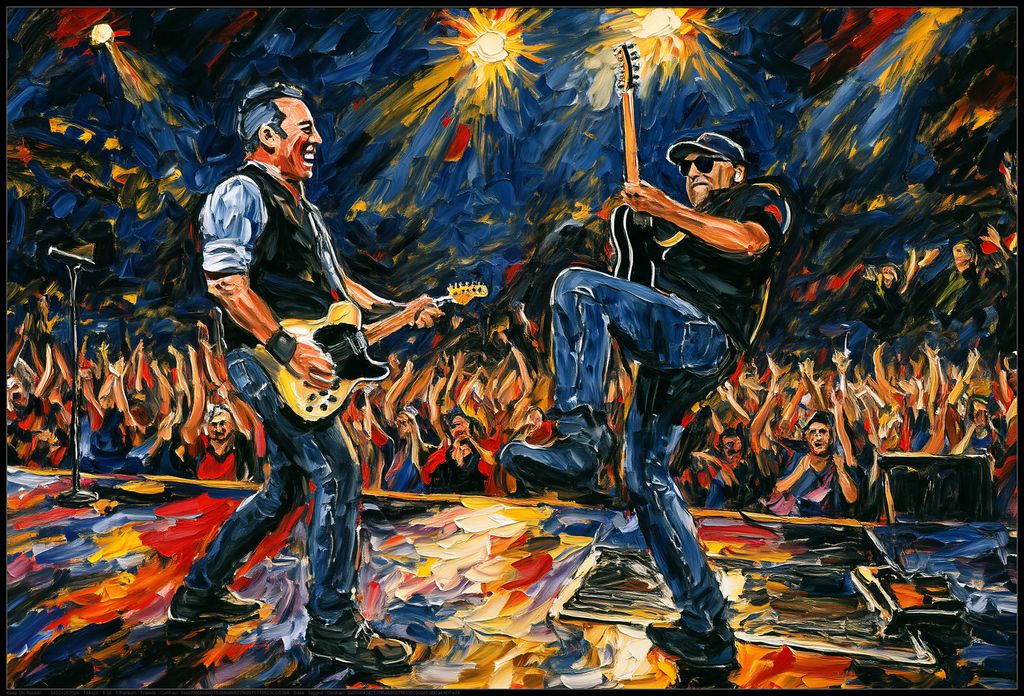
Worker Bee Monster Songs
Some songs become oldies.
Some become standards.
And some stubborn motherfuckers refuse to become history.
October 3, 2026, was crawling with them.
Songs written before many of the musicians onstage were born kept appearing throughout Power to the People. Not because somebody decided the festival needed a classic-rock segment. They appeared because the arguments buried inside them were still alive.
War.
Race.
Workers.
Poverty.
Immigration.
Environmental destruction.
Political power.
Who owns the country.
Who gets sent to fight.
Who gets protected.
Who gets fucked.
The oldest monster in the room was more than eighty years old.
Woody Guthrie — “This Land Is Your Land.”
Written in 1940, generations of Americans learned its beautiful, simple chorus while the sharper edges were often left behind.
On October 3, that sanitization became part of the performance.
Before the song began, the crowd was told that portions had historically been censored.
Tonight, they were going to sing them.
The introduction reached toward Indigenous people and stolen land. Guthrie's argument was pointed toward billionaires and oligarchs.
Then one of America's most familiar folk songs got passed around an absurdly crowded stage.
Bruce Springsteen.
Joan Baez.
Dave Matthews.
grandson.
DMC.
Tom Morello.
Different generations took possession of it for a few minutes. Some carried Guthrie. Some dragged him toward 2026.
The children's-song simplicity of the hook made the scene almost funny.
A stage full of punks, rappers, metal musicians and rock stars singing:
This land is your land.
That was the trick.
Everybody knew the hook.
Far fewer people knew the fight hiding underneath it.
—
Then came Mose Allison.
“Young Man Blues.”
1957
Allison wrote about a young man discovering that society didn't have much use for him.
The Who later turned the song into a live explosion, most famously around the Live at Leeds era.
Nearly seventy years after Allison, Foo Fighters pulled it into October 3.
And the old language moved slightly.
Young man. Young woman.
Tiny change.
Big distance traveled.
A song doesn't need to be embalmed to survive.
—
Bob Dylan — “Masters of War.”
1963
grandson—one of the youngest political voices repeatedly appearing throughout the festival—reached backward more than sixty years for Dylan's attack on people who profit while others die.
That collision alone tells half the story of the day.
A young artist didn't need a new song to describe every old obscenity.
Dylan had already left one lying around.
Then:
“Chimes of Freedom.”
1964
Near the end of the festival, Springsteen walked onto the stage alone.
Joan Baez joined him.
For a moment the spectacle disappeared.
Two people.
One song.
Baez had actually lived inside the era from which the song emerged. Springsteen had spent decades carrying pieces of that tradition forward.
Dylan wasn't there.
He didn't need to be.
The song was.
—
Stephen Stills — “For What It's Worth.”
1966
A song born from the Sunset Strip confrontations became one of those strange pieces of American vocabulary that escapes its original event.
Six decades later, Stills himself stood at Merriweather and sang it again.
That matters.
This wasn't somebody discovering an artifact.
The guy who wrote the warning was still standing there delivering it.
—
Creedence Clearwater Revival — “Fortunate Son.”
1969
Vietnam.
Class.
Privilege.
Patriotism used as costume by people whose children somehow avoid paying the bill.
By the final stretch of October 3, the stage was already growing.
Springsteen.
Morello.
Freedom Fighter Orchestra.
Dave Matthews.
Nathaniel Rateliff.
Then came the line that requires almost no historical footnote:
“It ain't me, I ain't no senator's son.”
Fifty-seven years later, everybody understood it.
Monster.
—
1970 produced two very different monsters.
Black Sabbath released “War Pigs.”
The Temptations released “Ball of Confusion.”
One came through heavy metal.
One came through Motown.
Both looked at the machinery around them and concluded something was deeply fucked.
At Merriweather, Jack Black fronted a young Sabbath configuration with Roman Morello, Revel Ian, Yoyoka Soma and Hugo Weiss.
Then Geezer Butler walked out for “War Pigs.”
There it was again:
the original generation physically standing beside the inheritors.
Meanwhile Public Enemy reached into Motown.
“Ball of Confusion.”
But they didn't simply polish the museum piece.
The musical skeleton carried language for another generation.
1970 entered 2026.
Then Public Enemy finished where Public Enemy inevitably leads:
“Fight the Power.”
Again.
—
1971
Marvin Gaye asked what humanity was doing to the planet.
“Mercy Mercy Me (The Ecology).”
Dave Matthews and Cindy Mizelle brought it back.
Pollution hadn't become quaint.
Environmental destruction hadn't become a solved chapter in a textbook.
Another monster still had work.
And John Lennon released:
“Power to the People.”
We'll come back to that one.
—
1979
The Clash.
“Clampdown.”
Workers become participants in the machinery that controls them.
Rebels grow older.
Power offers accommodations.
Forty-seven years later, Springsteen switched from acoustic to electric, Morello and his band joined him, and “Clampdown” entered the final sequence.
We already built an entire META around why that song still bites.
October 3 provided the answer:
because the Clampdown survived.
—
1989
Two more monsters arrived from opposite corners of music.
Neil Young:
“Rockin' in the Free World.”
Public Enemy:
“Fight the Power.”
Both returned on October 3.
During Neil Young's song, Springsteen and Morello attacked their guitars while Dave Matthews slipped pieces of the present into the words—including contemporary references that weren't sitting inside Young's 1989 original.
That is important.
The festival wasn't merely preserving old songs.
Sometimes it was updating the fucking software.
Public Enemy did the same thing through Ball of Confusion.
grandson and DMC did it inside Guthrie.
Dropkick Murphys reached into the history surrounding “The Men Behind the Wire” and reconsidered an old political song through circumstances they believed suddenly spoke to the present.
The songs weren't sacred objects.
They were tools.
—
Then there was Rage Against the Machine.
“Killing in the Name.”
1992
Morello didn't need to borrow history for that one.
He helped write it.
More than three decades later, its confrontation with institutional racism and obedience required remarkably little explanation.
Different decade.
Same command:
Fuck you, I won't do what you tell me.
Another monster reporting for work.
—
By the end of October 3, something strange had happened.
The festival had accidentally—or deliberately—assembled an American protest-song timeline:
1940 — This Land Is Your Land
1957 — Young Man Blues
1963 — Masters of War
1964 — Chimes of Freedom
1966 — For What It's Worth
1969 — Fortunate Son
1970 — War Pigs / Ball of Confusion
1971 — Mercy Mercy Me / Power to the People
1979 — Clampdown
1989 — Rockin' in the Free World / Fight the Power
1992 — Killing in the Name
Then:
2026.
New words entered old songs.
Old musicians stood beside young ones.
Dead writers spoke through living mouths.
The technology changed.
The guitars changed.
Hip-hop arrived.
Punk arrived.
Metal arrived.
The generations changed.
The fucking problems proved considerably harder to kill.
Maybe that's what makes a monster.
Not sales.
Not chart position.
Not whether everybody knows the chorus.
A monster is a song that survives long enough to meet the future—
and discovers the future still needs it.
—
6° ping
Woody Guthrie
→ Pete Seeger / American folk resistance
→ Bob Dylan
→ Joan Baez
→ civil rights / antiwar movements
→ Stephen Stills
→ For What It's Worth
→ Springsteen
→ working-class America
→ Tom Morello
→ Rage Against the Machine
→ political rock collides with hip-hop
→ Public Enemy
→ Fight the Power
→ grandson
→ Dylan's Masters of War
→ October 3, 2026.
Another branch:
Mose Allison
→ Young Man Blues
→ The Who
→ generations of loud guitar music
→ Foo Fighters
→ Dave Grohl
→ Josh Homme
→ Anthony Bourdain
→ back through the Bourdain universe.
Another:
Black Sabbath
→ Geezer Butler
→ heavy metal
→ War Pigs
→ Jack Black + Roman Morello + Revel Ian + Yoyoka Soma + Hugo Weiss
→ old monster placed in young hands.
Another:
Motown → The Temptations → Ball of Confusion → Public Enemy → Fight the Power.
Different bloodlines.
Same stage.
—
Breadcrumbs
• The oldest major historical song performed during the festival was “This Land Is Your Land,” written by Woody Guthrie in 1940.
• Guthrie's song contains politically sharper material often omitted from familiar schoolroom and communal versions.
• The October 3 introduction explicitly called attention to that history of censorship before the mass performance.
• “Young Man Blues” originated with jazz/blues songwriter Mose Allison in 1957, long before The Who's famous live interpretation.
• Foo Fighters' October 3 version altered the gender framing by bringing a young woman into the old lyric.
• “Masters of War” dates to Dylan's 1963 The Freewheelin' Bob Dylan.
• grandson performing it created a direct bridge between one of the festival's younger political performers and the early-1960s protest canon.
• “Chimes of Freedom” dates to 1964. Springsteen and Baez performing it together concentrated decades of protest history into two people and one song.
• Stephen Stills wrote “For What It's Worth” in 1966 after confrontations surrounding the Sunset Strip curfew protests. It was not originally a Vietnam War song, despite its later association with the broader protest era.
• “Fortunate Son” was released by Creedence Clearwater Revival in 1969 and attacked class privilege surrounding patriotic sacrifice and war.
• Black Sabbath's “War Pigs” and the Temptations' “Ball of Confusion” both emerged in 1970 from radically different musical traditions.
• Geezer Butler's physical presence during War Pigs turned historical lineage into something visible.
• Public Enemy's use of Ball of Confusion turned Motown history into contemporary political material rather than simply recreating the Temptations record.
• Marvin Gaye released “Mercy Mercy Me (The Ecology)” in 1971. Its environmental subject remains strikingly contemporary.
• Lennon released “Power to the People” in 1971. Fifty-five years later, its title supplied the identity of the festival itself.
• The Clash released “Clampdown” in 1979. Springsteen and Morello placed it inside the festival's final sequence.
• “Rockin' in the Free World” and “Fight the Power” both arrived in 1989, providing an accidental rock/hip-hop historical bookend.
• Dave Matthews introduced contemporary language during Rockin' in the Free World, demonstrating that October 3 sometimes treated historical songs as editable documents.
• “Killing in the Name” arrived in 1992 and connected Morello's own musical past directly to the festival's anti-racist and anti-authoritarian argument.
Some monsters were performed nearly intact.
Others were rewritten.
None were treated as dead.
History kept refusing to finish the job.
So the songs kept showing up for work.