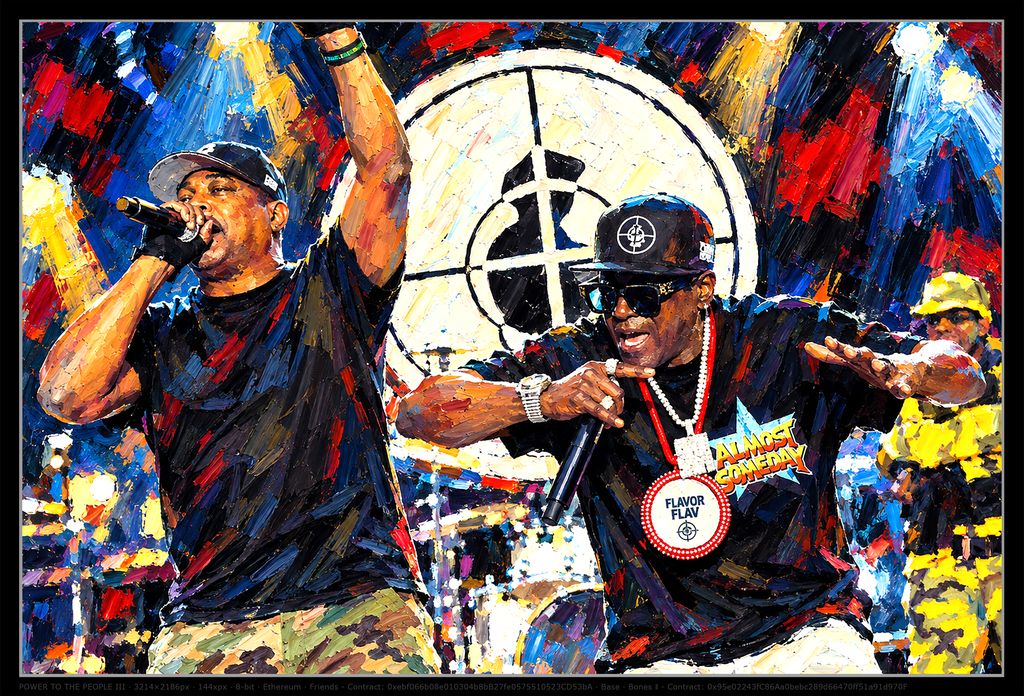
POWER TO THE PEOPLE III
October 3, 2026. Merriweather Post Pavilion. Outside Washington, D.C.
For one long day, music stopped pretending politics belonged somewhere else.
Tom Morello built Power to the People around a simple proposition: freedom, justice, equality and rock and roll belong in the same sentence.
Then he invited generations of troublemakers.
Joan Baez and Stephen Stills arrived carrying living connections to the protest movements of the 1960s. Bruce Springsteen brought a lifetime of songs about workers, outsiders and the American promise. Public Enemy brought Chuck D and Flavor Flav and nearly four decades of confronting racism and power. DMC carried hip-hop history. Geezer Butler carried Black Sabbath. Dave Grohl, Dave Matthews, Nathaniel Rateliff, Killer Mike, Cypress Hill, Dropkick Murphys, Serj Tankian, Taylor Momsen, Matt Cameron, Mike McCready, Brittany Howard, The Linda Lindas, grandson, Jack Black and a revolving army of musicians kept widening the circle.
Some people weren't there simply to sing.
Union leader Jimmy Williams Jr. spoke. January 6 police officer Michael Fanone appeared. Kneecap entered by video after being denied U.S. visas. Voter organizations were woven into the event. The Freedom Village put activism beside the merchandise and food.
And the kids weren't decoration.
Young musicians stood beside artists old enough to be their grandparents. Roman Morello, Revel Ian, Yoyoka Soma and Hugo Weiss played Black Sabbath with Jack Black. The Linda Lindas represented a generation that inherited punk rather than invented it. grandson repeatedly crashed through the day's boundaries, carrying contemporary politics into songs written before he was born.
The dead showed up too.
Woody Guthrie.
Bob Dylan through his songs.
John Lennon.
Marvin Gaye.
Mose Allison.
The Clash.
Creedence Clearwater Revival.
Neil Young's words.
Old songs kept walking back onto the stage because the problems inside them never completely left.
“Masters of War.”
“War Pigs.”
“For What It's Worth.”
“Fortunate Son.”
“Mercy Mercy Me.”
“Ball of Confusion.”
“Clampdown.”
“Rockin' in the Free World.”
“Fight the Power.”
Some were preserved. Some were bent. Some received new words for a new mess.
Public Enemy dragged the musical bones of Ball of Confusion from 1970 into 2026. Dave Matthews slipped contemporary horrors into Rockin' in the Free World. Dropkick Murphys reached backward to The Men Behind the Wire and reconsidered it through the present. A Mose Allison song from 1957 suddenly made room for a young woman. Songs became arguments across time.
But the day wasn't eleven hours of political homework.
There was ridiculousness. Jack Black blew harmonica during Sabbath. Cypress Hill ended by detonating Jump Around. Foo Fighters played giant communal rock songs. Morello's set became a revolving-door collision of Rage Against the Machine, Audioslave, hip-hop and hard rock. DMC, Chuck D, B-Real, Sen Dog, Flavor Flav, Scott Ian, Serj Tankian, Dave Grohl and others kept appearing and disappearing.
People laughed.
People screamed.
People sang stupidly enormous hooks.
That mattered too.
A movement fighting for a world without joy isn't offering much of a world.
Then the final stretch began.
Morello called Bruce Springsteen onto the stage.
Springsteen walked out alone.
Streets of Minneapolis.
The crowd answered with ICE OUT NOW.
Joan Baez joined him.
Two people standing together suddenly represented decades of American protest history.
They sang Dylan's “Chimes of Freedom.”
Then Morello and the Freedom Fighter Orchestra arrived. Springsteen switched to
electric.
“Clampdown.”
Dave Matthews and Nathaniel Rateliff joined the growing band.
“Fortunate Son.”
Dave Grohl arrived.
“Rockin' in the Free World.”
The stage kept filling until somebody essentially issued the order:
Everybody who performed today—come back.
And they did.
The final gathering reached all the way back to Woody Guthrie.
Before “This Land Is Your Land,” the audience was reminded that parts of the song had been censored and that tonight they would not be. Indigenous dispossession entered the introduction. Billionaires and oligarchs entered the argument.
Springsteen sang.
Baez sang.
Matthews sang.
grandson took it somewhere new.
DMC took it somewhere else.
Morello carried the sharp edge.
Behind them was an almost absurd wall of musicians from different generations and musical tribes singing one of the simplest folk hooks imaginable.
It was hooky, messy, political and beautiful.
Then came the last song.
John Lennon, 1971.
“Power to the People.”
The festival title became the chorus.
The chorus became the battle cry.
And after an entire day arguing against racism, fascism, hate, political cowardice and concentrated wealth, the instruction couldn't have been much simpler:
Power isn't something people should wait to receive.
Take part in it.
Vote.
Organize.
Make noise.
Protect somebody.
Stand beside people who don't look like you.
And when history hands another generation the same unfinished fucking argument—
show up.
—
6° ping
Woody Guthrie
→ songs about workers, poverty and ownership
→ Bob Dylan inherits the folk-protest language
→ Joan Baez carries those songs through civil rights and Vietnam-era America
→ Dylan's “Chimes of Freedom”
→ Baez + Bruce Springsteen, October 3, 2026
→ Springsteen + Tom Morello
→ The Ghost of Tom Joad
→ Steinbeck → migrants → workers → dispossession
→ Morello → Rage Against the Machine
→ Public Enemy / political hip-hop
→ Chuck D + B-Real + DMC collide inside Morello's set
→ Run-DMC → Aerosmith → “Walk This Way”
→ rock and hip-hop crash through an old wall
→ Dave Grohl → Nirvana/Foo Fighters
→ Morello → Chris Cornell/Audioslave
→ Cornell → Soundgarden
→ Matt Cameron + Taylor Momsen + Mike McCready + Robbie Mangano + Morello
→ Suns of Soundgarden
→ generations rebuilding music after the people who created it are gone.
Meanwhile:
Black Sabbath → Geezer Butler → “War Pigs” → Jack Black + teenage musicians → 2026.
And:
The Temptations → Motown → “Ball of Confusion” → Public Enemy → “Fight the Power” → October 3.
And:
Guthrie 1940 → Lennon 1971 → Morello 2026 → somebody who wasn't born yet.
That's the handoff.
—-
Breadcrumbs
• Power to the People was held October 3, 2026, at Merriweather Post Pavilion in Columbia, Maryland, outside Washington, D.C.
• Tom Morello framed the gathering around freedom, justice, equality and rock and roll, with voting and community action embedded in the event rather than separated from the music.
• The lineup crossed folk, punk, hip-hop, metal, classic rock, alternative rock, soul and younger-generation bands.
• Public Enemy appeared both as guests during Morello's sprawling set and later for their own set. “Fight the Power” therefore surfaced twice.
• Killer Mike combined rap, gospel/spiritual energy and an explicit push to vote and hold local officials accountable.
• Jack Sabbath connected Black Sabbath directly to another generation. Geezer Butler walked on for “War Pigs.”
• Suns of Soundgarden placed Taylor Momsen on vocals with Matt Cameron, Mike McCready, Robbie Mangano and Tom Morello, creating another unusually dense lineage inside a single temporary band.
• Serj Tankian joined Morello during his set, including a Chris Cornell/Audioslave connection through “Like a Stone.”
• DMC, Chuck D, B-Real, Sen Dog, Flavor Flav, Scott Ian, Jack Black, grandson and Dave Grohl moved through Morello's set rather than remaining isolated inside their own musical camps.
• Dropkick Murphys brought union representation directly onto the stage through Jimmy Williams Jr., president of IUPAT.
• Retired D.C. police officer and January 6 first responder Michael Fanone appeared during the Dropkick Murphys set.
• Kneecap appeared by video rather than physically onstage, adding another political thread to the day.
• Dave Matthews and Cindy Mizelle performed Marvin Gaye's “Mercy Mercy Me (The Ecology).”
• Matthews' portion later became a bridge into Joan Baez, Nathaniel Rateliff, Stephen Stills and Morello.
• “For What It's Worth” connected Stephen Stills directly to a song he wrote sixty years earlier.
• Public Enemy returned to “Ball of Confusion,” connecting the Temptations' 1970 Motown recording to contemporary political language.
• Foo Fighters reached back to Mose Allison's “Young Man Blues,” a song later made famous as a live weapon by The Who.
• The final Springsteen sequence began with one person and an acoustic guitar and progressively accumulated performers until much of the day's cast occupied the stage.
• The audience's ICE OUT NOW chant became part of the Streets of Minneapolis moment.
• Springsteen and Baez performing “Chimes of Freedom” together created one of the day's simplest but historically densest images.
• “This Land Is Your Land” was explicitly introduced through the history of its censored material before the mass performance.
• grandson and DMC each helped pull Guthrie's song toward the present rather than treating it as a museum piece.
• Morello connected Guthrie's message to Indigenous dispossession and concentrated wealth before the song was finished.
• The entire day finally collapsed into “Power to the People”—song, festival title, mass chant and send-off message becoming the same thing.
The music ended.
The argument didn't.