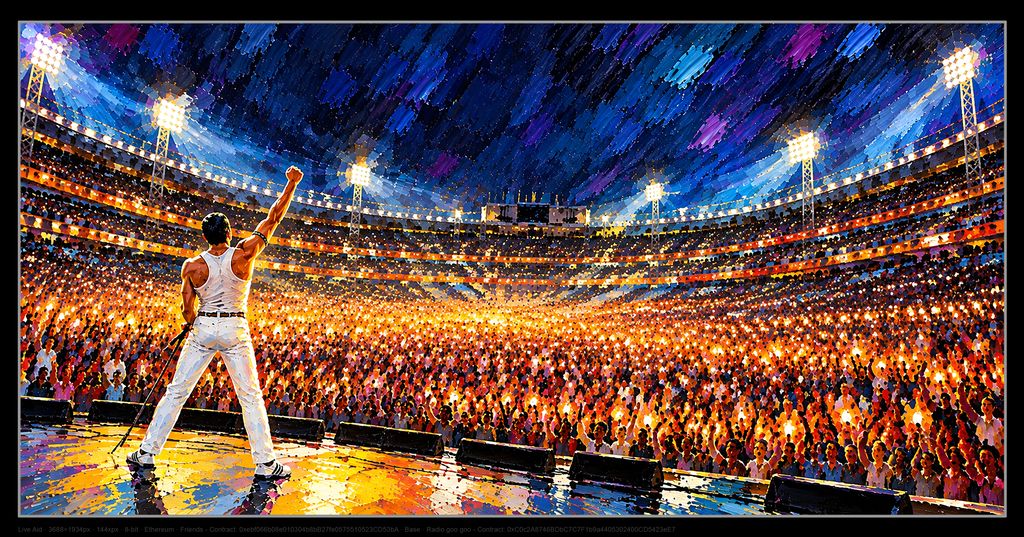
We Clap Together
“Radio Ga Ga” began with a playful sound. Queen made it a summons.
Its video borrowed the machinery and massed bodies of Fritz Lang’s Metropolis: workers swallowed by industry, lives organized around a relentless mechanical rhythm. Queen stepped inside that world with a song about radio, memory and the fear of being left behind. A band using television to defend an older medium. Pop laughing at the machine while feeding it something worth remembering.
Then came Wembley.
July 13, 1985. Freddie Mercury raised his arms, and the crowd answered. Hands overhead. Two claps. Thousands of individual movements finding the same instant.
The choreography had escaped the screen.
For a few minutes, the audience became part of the instrument. People who had arrived for different bands, carrying different histories, knew what to do together. Mercury gave them room to be enormous. The television cameras caught something no close-up of a star could contain: the pleasure of belonging to a sound.
Live Aid carried that electricity across an ocean.
At Wembley Stadium in London and John F. Kennedy Stadium in Philadelphia, Bob Geldof and Midge Ure assembled a musical relay for famine relief in Ethiopia. The machinery was vast: satellites, broadcast desks, revolving stages, telephone lines and donation appeals. Through it passed the smaller, less manageable things that make live music matter—a voice cracking, an unexpected guest, a crowd taking over.
U2 stretched “Bad” into an encounter that threatened to outrun its allotted time. David Bowie sang “Heroes.” Sting stepped into Dire Straits’ “Money for Nothing.” Elton John and George Michael shared “Don’t Let the Sun Go Down on Me.” Paul McCartney brought “Let It Be” to a stadium already carrying a day’s worth of noise and feeling.
Mercury and Brian May returned with a quieter question: “Is This the World We Created...?”
Across the Atlantic, Joan Baez sang “Amazing Grace.” Black Sabbath reunited with Ozzy Osbourne; Robert Plant, Jimmy Page and John Paul Jones stood together again. Run-DMC brought “King of Rock.” Madonna, Eric Clapton, the voices of the Temptations—different branches of popular music converged on the same urgent appeal.
Mick Jagger and Tina Turner supplied heat and swagger. Bob Dylan stood between Keith Richards and Ronnie Wood, sending “Blowin’ in the Wind” into another generation’s gathering. Phil Collins crossed the Atlantic to play both stages, giving the day’s improbable logistics a human itinerary.
The finales offered two invitations: “Do They Know It’s Christmas?” in London, “We Are the World” in Philadelphia.
The songs could gather people. What happened beyond the stadiums required money, work and decisions that applause could never replace. That distance belongs in the memory too: between the ease of singing together and the difficulty of answering another person’s need.
Yet the hands remain.
Raised above Wembley. Waiting for the beat. Coming together.
This work holds that moment when a familiar song becomes a shared physical act—when the crowd stops watching itself on the screen and makes something the screen can only follow.
Pop as uprising. Presence as power.
We clap together—and joy becomes rebellion.