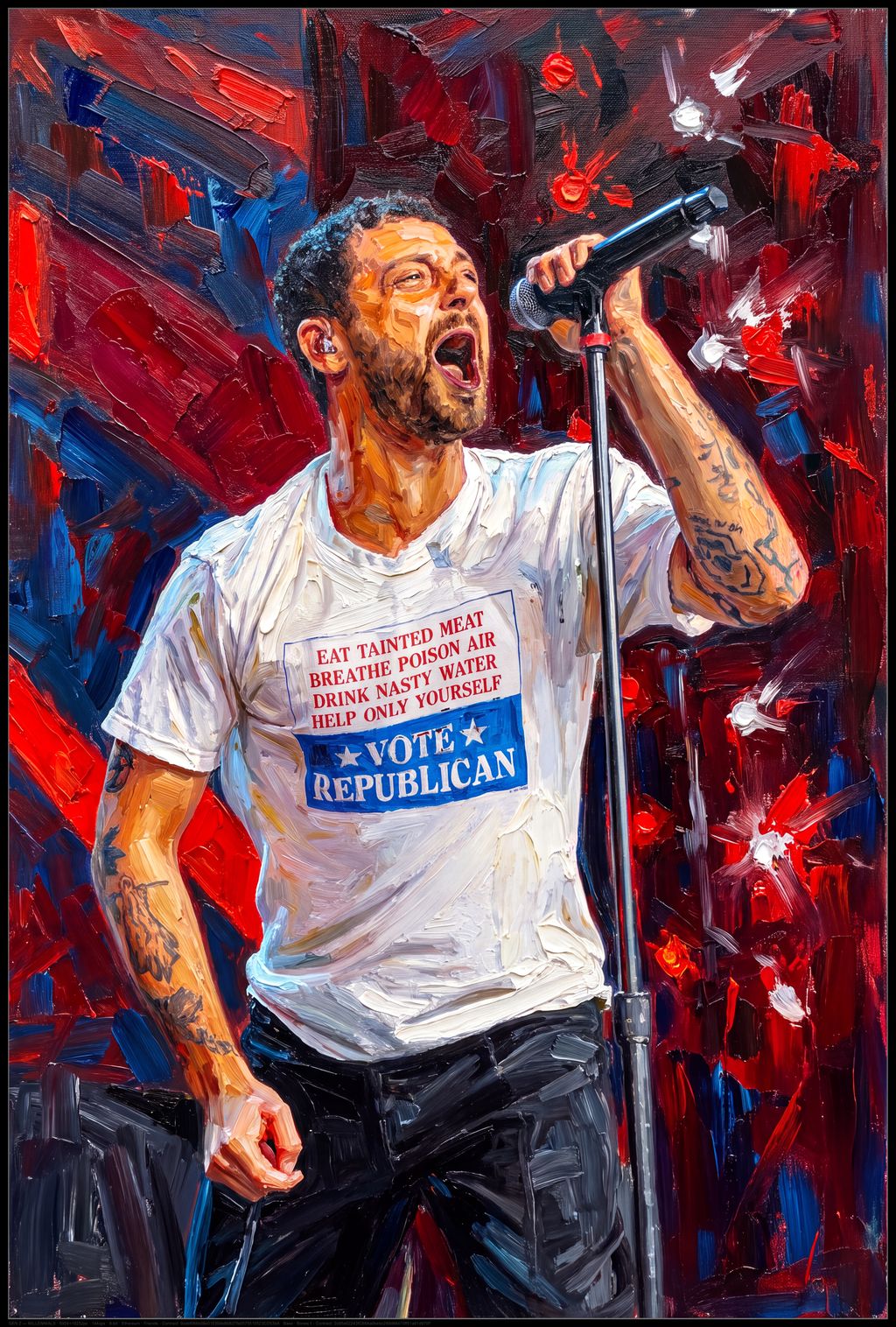
GEN Z — MILLENNIALS
THE FUTURE DIDN'T WAIT FOR PERMISSION
Power To The People — October 3, 2026
Merriweather Post Pavilion, Columbia, Maryland
Nobody handed the next generation a microphone as a ceremonial gesture.
They already had one.
At Power To The People, the young weren't there to admire the legends, study the history, or politely inherit somebody else's revolution. They came armed with guitars, microphones, drums, political fury, and a healthy disregard for the idea that protest music belongs to the past.
The old guard brought the history.
The next generations brought the unfinished business.
And for eleven-plus hours, those histories collided.
This wasn't a festival divided into yesterday's heroes and tomorrow's hopefuls. The young were already inside the machinery, making noise, playing alongside the architects, and dragging decades-old songs into a world their original writers could scarcely have imagined.
The stage didn't have a generational border.
And nobody was checking birth certificates.
THE KIDS ARE ALRIGHT. THE SYSTEM, NOT SO MUCH.
The Linda Lindas arrived carrying the beautiful contradiction of punk rock: a musical rebellion old enough to have grandparents, still young enough to piss off the establishment.
They weren't performing a museum piece. They were living proof that punk's original proposition remains wonderfully simple: you don't need permission, a corporate blessing, or a committee of old men to make yourself heard.
Plug in. Turn up. Say something.
A few decades earlier, young musicians had been screaming about war, racism, sexism, conformity, and the machinery of power. The Linda Lindas stepped into that lineage without treating it as sacred property.
Punk isn't an antique.
It's a tool.
And every generation gets to swing it.
Then there was grandson.
Not interested in subtlety. Not interested in waiting until the audience figured out which side he was on.
His set delivered a furious collision of contemporary rock, rap, electronic aggression, political theater, and blunt-force confrontation.
“My president's a felon.”
Not exactly a lyric designed to win bipartisan applause.
Actors portraying Donald Trump and Jeffrey Epstein turned part of the performance into grotesque political satire. The music was confrontational, the imagery deliberately uncomfortable, and the message unmistakable.
But one of grandson's most revealing moves wasn't about the present.
It was about the past.
He reached all the way back to Bob Dylan's “Masters of War.”
A song born in the shadow of the Cold War, when young people were staring down nuclear annihilation and powerful men were manufacturing reasons to send other people's children into battle.
More than six decades later, another young performer picked up the accusation.
Different century. Different wars. Different machinery.
Same damn indictment.
And grandson didn't disappear after his own set. He joined Tom Morello's musical uprising and returned for the mass finale, adding his voice to Woody Guthrie's “This Land Is Your Land.”
Dylan to Guthrie. Protest folk to modern political rock.
Not a tribute.
A continuation.
WAR PIGS AND THE CHILDREN OF SABBATH
Then came one of the day's most delicious collisions.
Jack Sabbath.
Jack Black fronting a temporary assembly of young musicians: Roman Morello, Revel Ian, Yoyoka Soma, and Hugo Weiss.
The names themselves carried a little rock-and-roll family history. But family connections don't play instruments. Musicians do.
And these musicians came ready.
They tore into the world of Black Sabbath and Ozzy Osbourne, including “Mr. Crowley,” “The Wizard,” and “War Pigs.”
Then Geezer Butler joined them.
One of the original architects of heavy metal standing alongside musicians young enough to be his grandchildren.
Think about that.
In 1970, Black Sabbath released “War Pigs,” a savage condemnation of politicians who manufacture wars while leaving ordinary people to do the dying.
In 2026, the song was still relevant.
That's simultaneously a triumph for the music and a miserable report card for civilization.
But watching its original bassist share that warning with another generation offered something beyond nostalgia.
The music survived its moment.
The message survived its creators' youth.
And the next generation knew exactly what to do with it.
Turn it up.
NEW VOICES. OLD GHOSTS. LOUD GUITARS.
Taylor Momsen took the microphone for Suns of Soundgarden, standing alongside Matt Cameron, Mike McCready, Robbie Mangano, and Tom Morello.
Soundgarden's music carries enormous emotional weight, particularly in the absence of Chris Cornell.
Momsen wasn't there to erase that absence.
She brought her own voice into the space, performing music that belonged to a previous explosion of rock culture while demonstrating that its energy could travel forward.
“Loud Love.” “Outshined.” “Spoonman.”
Seattle's musical history met a new voice under the Maryland lights.
Elsewhere, Brittany Howard widened the palette.
Soul. Blues. Gospel. Rock. American roots music.
Her presence was a reminder that resistance doesn't have to arrive wearing combat boots and screaming through a distorted amplifier.
Sometimes it comes wrapped in a voice that can carry tenderness, anguish, defiance, and enormous power within the same breath.
And The Last Internationale brought politically charged rock and working-class concerns into the day's larger argument.
The Neighborhood Kids added another contemporary presence.
Different sounds. Different approaches. Different cultural starting points.
Not one approved musical language for rebellion.
An entire vocabulary.
NO PASSPORT FOR RESISTANCE
Across the Atlantic, Kneecap entered the festival through a screen.
The Belfast hip-hop group appeared by video rather than physically taking the stage, with Morello introducing the segment and addressing the circumstances surrounding their inability to appear in the United States.
Their collaboration, “Unconquered,” carried the message across borders anyway.
Irish-language rap.
A politically outspoken group from Northern Ireland.
An American festival drawing connections between music, censorship, immigration, Palestine, and the right to dissent.
The irony was difficult to miss.
A border could prevent the musicians from entering the country.
It couldn't prevent their music from entering the conversation.
And that was the larger story.
Young political music wasn't confined to American punk clubs, hip-hop scenes, or rock stages.
It was international.
Connected.
Digitally fluent.
And increasingly unwilling to accept that the boundaries drawn by governments should define the boundaries of solidarity.
THE REVOLUTION HAS A BACKING BAND
The famous names were only part of the picture.
Look beyond the front microphones.
Look at the guitarists, bassists, drummers, keyboard players, backing singers, gospel voices, and rotating ensembles that made this marathon possible.
The Freedom Fighter Orchestra was the musical engine underneath Morello's constantly changing cast.
The players and singers surrounding Killer Mike helped carry a performance that moved between rap, gospel, and civic urgency.
The additional vocal ensembles brought collective energy to music that was already demanding collective action.
And across the festival, the larger supporting bands, guest musicians, and stage ensembles represented a far wider human network than the marquee names could ever capture.
Not every performer had a biography projected onto the giant screens.
Not every voice received an individual introduction.
And no one needs an exact age attached to their name to recognize the generational breadth of what happened.
The future wasn't represented only by the youngest person holding a microphone.
It was represented by the enormous network of musicians helping keep the entire machine moving.
Young players alongside veterans.
New voices inside old songs.
Different generations working the same stage, often inside the same arrangement.
The most powerful thing about the festival wasn't simply that young artists were invited.
It was that the music depended on them, too.
THE HANDOFF THAT WASN'T A HANDOFF
There is something comforting about the familiar story of generations passing a torch.
One group grows old.
Another steps forward.
The old guard offers its wisdom, the young accept the responsibility, and history continues in a neat, respectable line.
That isn't what happened here.
Nobody waited for the torch.
They grabbed their own matches.
Joan Baez carried the civil-rights and antiwar traditions of the 1960s.
Stephen Stills brought “For What It's Worth.”
Geezer Butler carried the original DNA of “War Pigs.”
Public Enemy brought the revolutionary force of political hip-hop.
Tom Morello connected decades of rock, rap, metal, and activism.
And around them, newer generations were already playing, singing, challenging, rewriting, and making those traditions their own.
The festival wasn't a relay race.
It was a collision.
The past didn't leave the stage so the future could enter.
They occupied it together.
By the finale, Springsteen, Baez, Morello, Dave Matthews, Nathaniel Rateliff, grandson, and an expanding gathering of performers were pulling songs from across generations into one enormous communal argument.
“This Land Is Your Land.”
“Power to the People.”
Words written long before many of the musicians onstage were born.
Words still waiting for the world to catch up.
And there stood the next generations, not asking whether they belonged in the chorus.
Singing it.
Because the struggle against racism, authoritarianism, inequality, political corruption, war, and concentrated power doesn't have an expiration date.
Neither does the music.
The generation that marched in the 1960s didn't finish the job.
Neither did the punks of the 1970s.
Neither did the hip-hop revolutionaries of the 1980s.
Neither did the alternative-rock rebels of the 1990s.
And the generations carrying the fight today won't finish it alone.
But that was never the requirement.
The requirement was to show up.
Make noise.
Refuse silence.
And leave something louder for whoever comes next.
The future didn't wait for permission.
It plugged in.
It took the stage.
And it turned the fuck up.
6° PING — GENERATIONAL COLLISIONS
-Grandson → Bob Dylan → Woody Guthrie → Bruce Springsteen
“Masters of War” carried Dylan's early-1960s antiwar fury into grandson's contemporary set. Later, grandson contributed to Guthrie's “This Land Is Your Land” during the Springsteen-led finale. Two historical protest traditions meeting inside one young artist's performance day.
-Roman Morello → Tom Morello → Rage Against the Machine → Black Sabbath → Geezer Butler
A young guitarist sharing a stage with an original heavy-metal architect, connected through a father whose own career helped redefine political rock.
-Revel Ian → Scott Ian → Anthrax → Public Enemy → Chuck D
Family lineage meeting musical lineage. Anthrax and Public Enemy helped smash genre barriers with “Bring the Noise.” Their worlds converged again at the festival, while another generation of musicians participated in the larger event.
-Taylor Momsen → Soundgarden → Chris Cornell → Audioslave → Tom Morello
Momsen performed Soundgarden material with musicians connected to the band's history. Morello's Audioslave years provided another direct bridge to Cornell, whose musical legacy echoed throughout the day.
-The Linda Lindas → Punk Rock → Political Rock → Tom Morello
A younger punk band standing inside a festival whose musical ancestry stretches through decades of punk confrontation, anti-authoritarian rock, and cross-genre rebellion.
-Kneecap → Belfast → Irish Political Music → Dropkick Murphys → American Labor Politics
Different countries and musical languages, connected by histories of identity, conflict, working-class struggle, and resistance.
BREADCRUMBS — BONES FOR THE ARCHIVE
-1963: Bob Dylan releases “Masters of War” on The Freewheelin' Bob Dylan. Grandson performs the song at the 2026 festival.
-1970: Black Sabbath releases “War Pigs” on Paranoid. Geezer Butler returns to the song alongside young musicians fifty-six years later.
-1986: Run-DMC and Aerosmith's “Walk This Way” becomes a landmark rock/hip-hop crossover. DMC participates in another genre-colliding festival forty years later.
-1991: Public Enemy and Anthrax release their collaborative version of “Bring the Noise,” helping connect politically confrontational hip-hop and thrash metal.
-1990s: Soundgarden and Rage Against the Machine establish different but influential musical lineages that later intersect through Chris Cornell and Audioslave.
-2026: Grandson performs “Masters of War,” Jack Sabbath revisits “War Pigs,” Kneecap appears by video, and the festival finale brings younger and older performers together around Guthrie and Lennon.
The generational thesis: This wasn't a nostalgic celebration of protest music with a few young performers added for balance. It was a working demonstration that resistance is a living culture, renewed by the people who inherit its unfinished arguments and refuse to leave them unfinished.