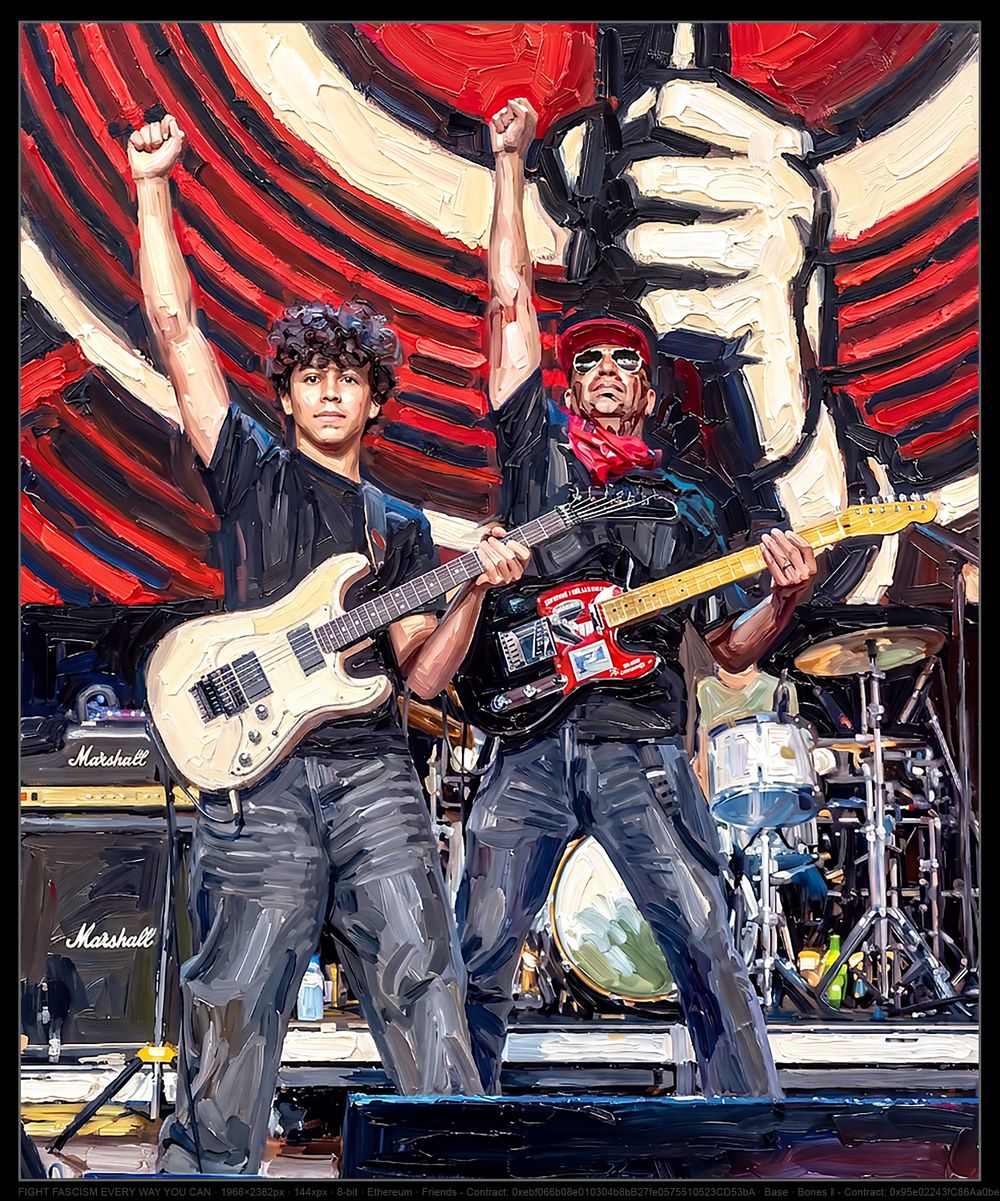
FIGHT FASCISM EVERY WAY YOU CAN
Tom Morello didn't invent the sentence.
His mother did.
Mary Morello.
Teacher. Activist. Organizer. A woman who reached one hundred years old having apparently decided that shutting the fuck up was never particularly useful.
Her instruction was simple:
Fight fascism every way you can.
Voting is one of those ways.
That idea sat underneath Power to the People from the beginning.
This wasn't simply a concert where politically inclined musicians happened to gather.
It was October 3, 2026.
One month before an American midterm election.
Outside Washington, D.C.
And Morello had assembled generations of musicians around an argument:
Democracy doesn't defend itself.
—
Fascism rarely announces itself by saying:
Hello. We're the fascists.
It arrives wrapped in other words.
Order.
Security.
Patriotism.
Tradition.
Enemies.
Invaders.
Criminals.
Traitors.
The people destroying your country.
The people who don't belong.
The language changes.
The machinery is ancient.
Find somebody weaker.
Blame them.
Convince frightened people that cruelty is strength.
Convince ordinary workers that another ordinary worker is the reason their life is getting harder.
Then convince everyone that only a strong enough leader can fix it.
Music has been arguing with that sales pitch for a very long time.
—
Woody Guthrie did.
Pete Seeger did.
Joan Baez did.
Bob Dylan did.
The Clash did.
Public Enemy did.
Rage Against the Machine did.
Springsteen did.
And on October 3, a ridiculous number of those bloodlines collided.
Public Enemy didn't hide behind nostalgia.
Chuck D and Flavor Flav spoke directly about racism, hate and fascism.
Then they played “Fight the Power.”
Twice that day, in fact—the song also erupting earlier inside Morello's sprawling guest set.
That repetition almost became punctuation.
Fight the Power.
Keep going.
Fight the Power.
Still not finished.
—
Killer Mike attacked from another direction.
His message wasn't:
Wait for a rock star to save you.
It was:
Vote.
Locally.
Soon.
Pay attention to the people who actually govern where you live.
That may sound less romantic than smashing a guitar.
It's also how democracy works.
The boring machinery matters.
School boards matter.
Judges matter.
Prosecutors matter.
Local officials matter.
Congress matters.
Elections matter.
The ballot box isn't the entire fight.
It is one of the fucking tools.
Mary Morello's point exactly.
—
Then there was Michael Fanone.
No guitar.
No hit record.
A retired Washington police officer who defended the Capitol on January 6, 2021.
Five years later, he walked onto the stage during a Dropkick Murphys set.
That image carried its own history.
The festival's politics weren't anti-government as some adolescent abstraction.
They were anti-authoritarian.
Those are not the same thing.
A police officer who physically defended the peaceful transfer of political power could stand inside the same festival as Rage Against the Machine's guitarist.
No contradiction required.
The common ground was democracy.
—
And then there was another man who apparently didn't need to walk onstage at all.
Jack Smith.
During Foo Fighters' set, Dave Grohl dedicated “My Hero” to a man he described as his new friend Jack.
The reported Jack was former special counsel Jack Smith, watching from the audience.
Think about that breadcrumb.
A federal prosecutor who investigated a former president sitting somewhere inside a gigantic protest-rock festival while Dave Grohl dedicates “My Hero” to him.
No speech required.
If that survives our final evidence scrub, it stays.
Because sometimes history hides in the audience.
—
Immigration ran through the day too.
Not as an abstract policy seminar.
As people.
As music.
As accusation.
Kneecap couldn't physically join the festival.
They entered by screen.
Morello used their absence to attack the circumstances surrounding their inability to appear in the United States.
Serj Tankian brought another immigrant story into the musical coalition.
Dropkick Murphys turned directly toward immigration enforcement with “Citizen I.C.E.”
Springsteen began the final sequence with “Streets of Minneapolis.”
Then the crowd started chanting:
ICE OUT NOW.
Nobody had to explain the connection.
The audience had entered the argument.
—
grandson approached fascism with considerably less subtlety.
His set included a repeated line:
“My president's a felon.”
Then came Dylan's “Masters of War.”
And somewhere in the performance, theatrical versions of Donald Trump and Jeffrey Epstein entered the spectacle.
It was ugly.
Funny.
Crude.
Provocative.
Exactly the kind of political theater that respectable people frequently complain has gone too far.
Political art has been hearing that complaint for centuries.
Sometimes the point is to go too fucking far.
—
Dropkick Murphys reached backward.
“The Men Behind the Wire.”
An old political song carrying the weight of Northern Ireland.
The band reportedly explained that they historically resisted performing it because the experience described wasn't theirs.
Now they believed parts of its warning had become newly relevant.
That distinction matters.
They weren't claiming somebody else's history.
They were asking whether history had begun rhyming loudly enough to borrow its alarm.
That is exactly what October 3 kept doing.
Old songs.
New circumstances.
Same alarms.
—
Then Springsteen arrived.
Alone.
Acoustic guitar.
No giant band to hide behind.
Before the finale became a celebration, he framed the political moment directly.
Then:
“Streets of Minneapolis.”
The ICE chants.
Baez arrived.
“Chimes of Freedom.”
Morello and the Freedom Fighter Orchestra arrived.
Springsteen switched to electric.
“Clampdown.”
There it was.
The Clash's warning about ordinary people being absorbed into systems of power.
Then The Ghost of Tom Joad.
Then Fortunate Son.
Then Rockin' in the Free World.
The finale wasn't randomly selecting famous protest songs.
It was building an argument.
Authoritarianism.
Freedom.
Workers.
Poverty.
Class privilege.
War.
America's promises.
America's failures.
—
Eventually almost everybody came back.
And they sang “This Land Is Your Land.”
But before they did, the sanitized version of Guthrie was called out.
The missing verses mattered.
The stolen land mattered.
The people fenced out mattered.
The billionaires and oligarchs mattered.
The song was restored to political use.
Then grandson changed it.
DMC changed it.
Different voices took pieces.
An eighty-six-year-old folk song became an open-source political document.
And finally:
“Power to the People.”
John Lennon.
1971
Everyone.
2026
That wasn't subtle either.
Good.
—
The easiest way to misunderstand fascism is to imagine it only as the final photograph.
Uniforms.
Flags.
Soldiers.
Prisons.
By then the interesting decisions have already been made.
The earlier decisions are smaller.
Who gets scapegoated?
Who gets dehumanized?
Who gets silenced?
Who gets frightened?
Who decides obedience is safer?
Who decides politics is somebody else's problem?
Who decides not to vote because both sides annoy them?
Who looks away because the person being targeted isn't part of their tribe?
That's where Mary Morello's sentence becomes useful.
Fight fascism every way you can.
Sing.
Write.
Organize.
March.
Teach.
Unionize.
Make art.
Protect somebody.
Call bullshit.
Vote.
And when necessary—
make enough fucking noise that the people in Washington can hear you.
—
6° ping
Mary Morello
→ teacher
→ organizer
→ raises Tom Morello
→ Rage Against the Machine
→ Killing in the Name
→ institutional racism / obedience
→ Public Enemy
→ Fight the Power
→ DMC
→ hip-hop as political/cultural disruption
→ grandson
→ Masters of War
→ Dylan
→ Baez
→ civil-rights movement
→ Springsteen
→ October 3, 2026
→ back to Mary:
Fight fascism every way you can.
—
Another route:
January 6
→ Michael Fanone
→ democracy under physical attack
→ Dropkick Murphys stage
→ organized labor / Jimmy Williams Jr.
→ workers
→ Clampdown
→ Springsteen + Morello
→ authoritarian power
→ Mary Morello.
—
And the wonderfully weird one:
Jack Smith
→ federal prosecution
→ guy standing in a concert audience
→ Dave Grohl
→ My Hero
→ Foo Fighters
→ Grohl joins Springsteen/Morello later
→ Rockin' in the Free World
→ Neil Young
→ 1989
→ Public Enemy
→ Fight the Power.
History occasionally writes like a drunk screenwriter.
—
Breadcrumbs
• Mary Morello's anti-fascist activism is a genuine part of Tom Morello's political formation, not retrospective branding.
• Her message provides one of the cleanest organizing principles for the entire festival: political resistance requires multiple tools, including voting.
• Power to the People occurred roughly one month before the 2026 midterm elections, making the festival's voter-registration work part of the story rather than background decoration.
• HeadCount and VoteRiders were connected to the event's civic-engagement mission.
• Killer Mike used his stage time to emphasize voting and local political accountability.
• Public Enemy explicitly confronted racism, hate and fascism during its standalone set.
• “Fight the Power” appeared twice during the day—inside Morello's guest-heavy set and again as Public Enemy's closer.
• Michael Fanone's appearance during Dropkick Murphys connected the festival directly to the January 6 attack on the Capitol.
• Jimmy Williams Jr. brought organized labor into the same set, widening the political coalition beyond musicians.
• The reported Jack Smith / Dave Grohl “My Hero” moment remains a delicious breadcrumb, but should receive one final evidence check before minting.
• Kneecap's participation was virtual/video rather than a physical stage appearance.
• Morello used the Kneecap segment to address their inability to appear physically in the United States; exact language should remain paraphrased until transcript-level verification.
• Dropkick Murphys' treatment of “The Men Behind the Wire” deserves preservation because the band's explanation about previously avoiding the song is as important as the performance itself.
• Springsteen's opening remarks before the final sequence need exact transcription before quotation; our video scrub clearly establishes the anti-fascist framing but not every word.
• ICE OUT NOW became audience participation during Streets of Minneapolis.
• Guthrie's censored/omitted verses were explicitly discussed before “This Land Is Your Land.”
• The mass finale moved from resistance to participation: performers returned, historical songs were rewritten, and the audience became part of the sound.
• Lennon supplied the final instruction:
POWER TO THE PEOPLE.
Not power to the singer.
Not power to the billionaire.
Not power to the strongman.
To the people.
Contract
0xebf0...53ba
Network
Ethereum
Token ID
9
Seller
0x3472...7119
Artist
stickyMETA