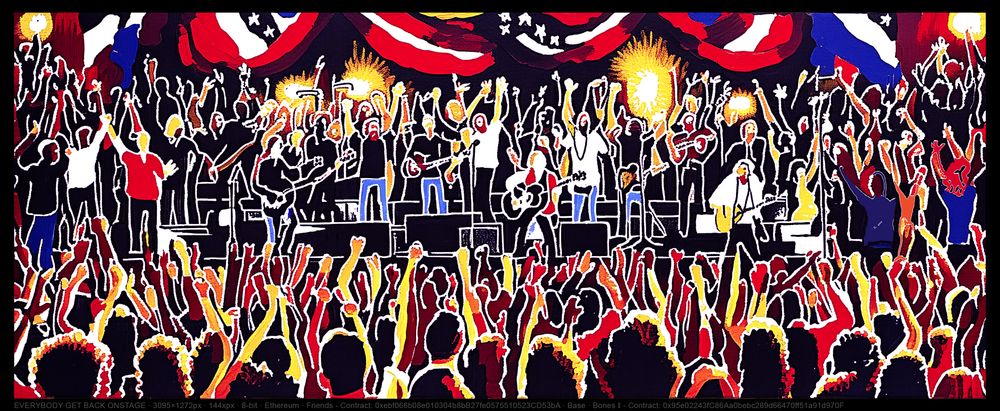
EVERYBODY GET BACK ONSTAGE
For most of October 3, Power to the People kept expanding.
A folk singer would appear.
Then a rapper.
Then Sabbath.
Then punk.
Then Soundgarden.
Then a union leader.
Then a cop.
Then somebody on a video screen.
Then another guest would walk into Tom Morello's set and nobody seemed particularly interested in closing the door behind them.
But near the end, the entire idea became physical.
It started with almost nothing.
Bruce Springsteen walked out alone.
Acoustic guitar.
After roughly ten hours of bands, guests, distortion, speeches, hip-hop, metal and political theater, one person stood there.
Then he began:
“Streets of Minneapolis.”
The present tense.
Immigration enforcement.
America now.
And the audience answered:
ICE OUT NOW.
Already the border between stage and crowd was breaking.
—
Then Springsteen reached backward.
Joan Baez walked out.
Bob Dylan.
1964
“Chimes of Freedom.”
This was the opposite of spectacle.
Springsteen and Baez didn't need forty people behind them.
Look at the two humans.
Baez had marched, organized and sung when the modern American protest-song tradition was still being written.
Springsteen had spent half a century writing about the people living underneath American mythology.
Two generations.
One old Dylan song.
For a few minutes, that was enough.
Then the fucking doors opened.
—
Tom Morello returned with the Freedom Fighter Orchestra.
Springsteen traded acoustic for electric.
The finale stopped looking backward politely.
“Clampdown.”
The Clash.
1979
Workers.
Authority.
Accommodation.
The machine.
Joe Strummer was dead.
The warning wasn't.
Then:
“The Ghost of Tom Joad.”
Springsteen and Morello.
Steinbeck hiding inside Springsteen hiding inside Rage Against the Machine.
Workers.
Migrants.
People sleeping under bridges.
People the country prefers not to see.
Another layer enters the room.
—
Then Nathaniel Rateliff and Dave Matthews join.
The stage gets wider.
“Fortunate Son.”
1969
Creedence Clearwater Revival.
The privileged sending somebody else's kid to war.
It ain't me.
The song is nearly sixty years old.
The target still understands the accusation.
Monster.
—
Then Dave Grohl arrives.
Neil Young.
1989
“Rockin' in the Free World.”
Now look at the fucking stage.
Springsteen.
Morello.
Matthews.
Rateliff.
Grohl.
Freedom Fighter Orchestra.
Different musical bloodlines piled on top of one another.
Springsteen and Morello trading guitar fire inside somebody else's song.
Matthews starts pulling the lyric toward 2026.
School shootings.
Trees becoming toilet paper.
The song isn't frozen.
Neil Young gave them the chassis.
They drove it into the present.
And still the stage wasn't full enough.
—
Then somebody effectively says:
Everybody who performed today—get back out here.
And they do.
The festival stops being a sequence of sets.
It becomes a photograph.
People who had occupied separate musical universes all day begin filling the same frame.
Joan Baez.
Springsteen.
Morello.
Matthews.
Grohl.
Rateliff.
grandson.
DMC.
And an expanding mass of the day's musicians and voices.
At that point, trying to assign everybody a genre becomes comedy.
Which is perfect.
Because the next song belongs to a man who died almost sixty years earlier.
Woody Guthrie.
—
“This Land Is Your Land.”
1940
One of the most familiar songs in America.
And one of the most successfully declawed.
Before they play it, the missing teeth become part of the introduction.
The song has been censored.
Verses disappear.
The uncomfortable Guthrie gets replaced by campfire Guthrie.
Not tonight.
The political argument comes back.
Private property.
People being excluded.
Indigenous land.
Billionaires.
Oligarchs.
Who exactly does this land belong to?
Then they start singing.
And suddenly this enormous edgy stage full of rockers, rappers, punks and professional troublemakers is singing one of the hookiest folk choruses ever written.
It's almost ridiculous.
That's why it works.
—
Springsteen gets a piece.
Baez gets a piece.
Matthews gets a piece.
Then something more interesting happens.
The song starts changing hands.
grandson.
A young political artist takes Guthrie and drags him toward his own America.
Then:
DMC.
A founding figure of hip-hop's mainstream breakthrough takes another swing at an 86-
year-old folk song.
Stop there for a second.
Woody Guthrie.
Darryl McDaniels.
Same song.
Same stage.
That shouldn't feel inevitable.
October 3 somehow makes it feel obvious.
Then Morello moves toward the material usually left outside the schoolbook version.
The history gets uglier.
The chorus stays beautiful.
Everybody keeps singing.
The audience knows exactly when to come in.
That's the fucking magic trick.
You can hide an argument inside a chorus people want to sing.
—
Somewhere around this giant mess comes another idea:
The arts will get us out of this shit.
Not by themselves.
A guitar cannot pass legislation.
A song cannot cast a ballot.
A painting cannot stop a deportation.
A rapper cannot personally dismantle an oligarchy.
But art can do something politics frequently fails to do.
It can put people who don't belong to the same tribe into the same emotional space.
For five minutes, everybody knows the words.
For five minutes, the stranger next to you isn't an abstraction.
For five minutes, history stops being something that happened to dead people.
You're inside it.
That's power too.
—
Then October 3 has one move left.
The festival has already used Guthrie.
Dylan.
The Clash.
Creedence.
Neil Young.
Springsteen.
Public Enemy.
Rage.
Motown.
Sabbath.
The stage is already overflowing.
So the last song doesn't need a complicated lyric.
It needs a command everybody can remember.
John Lennon.
1971
“Power to the People.”
And that's it.
The title of the festival finally becomes the song.
The song becomes a chant.
The chant becomes the entire stage.
The stage hands it to the audience.
After ten hours of individual artists, individual genres, individual histories and individual fights, the final image isn't an individual at all.
It's everybody.
That may be the smartest piece of staging in the entire day.
The festival begins as a lineup.
It ends as a coalition.
Nobody wins the finale.
Nobody owns it.
There isn't one hero standing in the spotlight while everybody else applauds.
The spotlight effectively breaks.
And the message that survives is embarrassingly simple:
Get everybody back onstage.
The folk singer.
The rapper.
The punk.
The metalhead.
The immigrant.
The worker.
The cop who defended democracy.
The old fucker.
The kid.
The famous person.
The person whose name we're still trying to figure out.
Bring your history.
Bring your anger.
Bring your ridiculous guitar.
Bring your different language.
You don't have to become each other.
Just figure out what you're willing to stand together for.
Then make enough noise that somebody hears you.
—
6° ping
Woody Guthrie
→ This Land Is Your Land
→ Pete Seeger
→ Dylan
→ Joan Baez
→ Springsteen
→ The Ghost of Tom Joad
→ Tom Morello
→ Rage Against the Machine
→ political rock meets hip-hop
→ DMC
→ grandson
→ both eventually inherit pieces of Guthrie
→ giant October 3 stage.
The line doesn't end.
It folds back on itself.
—
Another:
CCR
→ Fortunate Son
→ Vietnam / class privilege
→ Springsteen
→ working-class America
→ Dave Matthews + Nathaniel Rateliff join
→ Neil Young
→ Rockin' in the Free World
→ Dave Grohl joins
→ everybody returns
→ Guthrie
→ Lennon.
The finale travels roughly:
1940 → 1964 → 1969 → 1971 → 1979 → 1989 → 1995 → 2026
Not chronologically.
Emotionally.
—
And the beautiful stupid one:
DMC
→ Run-DMC
→ Walk This Way
→ Aerosmith
→ rock meets hip-hop
→ Morello mashup
→ DMC survives the entire day's musical pinball machine
→ ends up singing fucking Woody Guthrie.
Perfect.
—
Breadcrumbs
• Springsteen began the final sequence alone with an acoustic guitar, making the later mass convergence dramatically larger.
• “Streets of Minneapolis” kept the opening rooted in 2026 rather than immediately retreating into historical protest songs.
• ICE OUT NOW chants turned the audience into an active participant almost immediately.
• Joan Baez joined Springsteen for Dylan's “Chimes of Freedom.”
• Morello and the Freedom Fighter Orchestra then entered, and Springsteen switched to electric.
• “Clampdown” connected the finale directly to The Clash and the worker/authoritarian themes running through the festival.
• “The Ghost of Tom Joad” connected Springsteen and Morello through a song they have repeatedly transformed together.
• Dave Matthews and Nathaniel Rateliff joined the expanding configuration for “Fortunate Son.”
• Dave Grohl joined for “Rockin' in the Free World.”
• Matthews introduced contemporary lyrical material into the Neil Young song, including references to school shootings and trees being cut down for toilet paper.
• Springsteen and Morello's guitar interplay during the Neil Young performance supplied one of the finale's strongest visual rock-and-roll moments.
• The call for the day's performers to return transformed the concert from rotating sets into one mass ensemble.
• Before “This Land Is Your Land,” the historical censorship/omission of Guthrie's sharper material was explicitly addressed.
• Indigenous dispossession, concentrated wealth and oligarchic power were folded into the song's 2026 framing.
• grandson and DMC each supplied their own contemporary contribution. Both matter.
• The performance worked partly because the politics rode inside an absurdly familiar communal chorus.
• The phrase about the arts getting us out of this shit deserves exact transcript verification before quotation in the minted version.
• “Power to the People” followed Guthrie and served as the final battle cry of the scrubbed concert.
• Lennon wrote and released it in 1971.
• Fifty-five years later, the song supplied the festival's title.
And after an entire day devoted to musicians using microphones—
the last message belonged to everybody.
Contract
0xebf0...53ba
Network
Ethereum
Token ID
11
Seller
0x3472...7119
Artist
stickyMETA