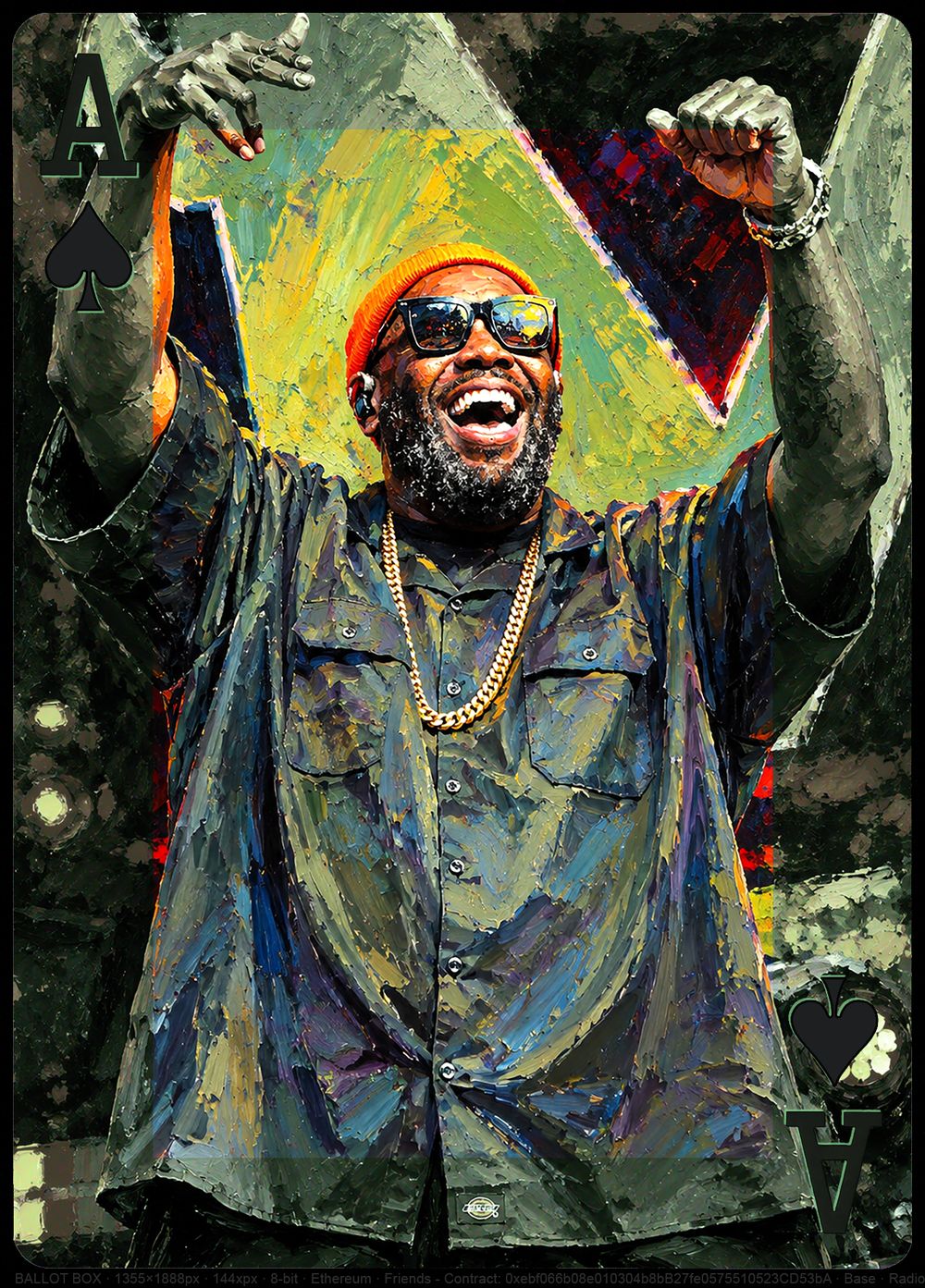
THE BALLOT BOX AND THE BATTLE CRY
Some rappers write about power.
Some spend their careers trying to figure out who actually holds it.
Killer Mike does both.
Atlanta. Hip-hop. Gospel. Black entrepreneurship. Civil rights. Police accountability. Economic justice. The ballot box.
A man who can deliver a furious political indictment over a beat and then tell the same audience to pay attention to its fucking school board.
Because the people making decisions about your neighborhood don't all work in the White House.
And the people with the loudest microphones don't necessarily have the power to change anything.
That distinction has become one of Killer Mike's defining arguments.
ATLANTA - THE MUSIC AND THE MACHINE
Michael Render came out of Atlanta's hip-hop universe, emerging nationally through Outkast and building a solo career that refused to separate Southern rap from the politics of the South.
His breakthrough included an appearance on Outkast's "Snappin' & Trappin'" and the Grammy-winning "The Whole World."
Then came the solo records.
Monster.
R.A.P. Music.
And eventually Run the Jewels, his partnership with producer and rapper El-P.
Two men from different musical backgrounds found a common language in enormous beats, confrontation, humor and political fury.
Run the Jewels could make music that sounded like a riot breaking out inside a machine shop.
But Killer Mike's politics were never limited to the recording studio.
He talked about policing.
Black ownership.
Banking.
Local elections.
Who controls neighborhoods.
Who gets the money.
Who gets the contracts.
Who gets protected.
And who gets left outside.
His recurring question was less about whether America had made promises than whether ordinary people possessed the economic and political leverage to make those promises mean anything.
THE MONEY QUESTION
Civil rights without economic power can become a beautiful speech delivered to somebody who still owns your building.
Killer Mike has spent years returning to that problem.
Black-owned businesses.
Community banking.
Financial literacy.
Entrepreneurship.
Ownership.
Keeping wealth circulating through communities historically excluded from it.
His Greenwood banking venture drew its name from Tulsa's Greenwood District, once known as Black Wall Street, devastated by racist violence in 1921.
The symbolism was deliberate.
But the underlying proposition was practical.
If people cannot accumulate capital, access credit, build businesses or influence the institutions distributing money, political equality remains incomplete.
That doesn't mean every entrepreneurial solution works.
It doesn't mean a banking app fixes structural racism.
It means Killer Mike insists that economic power belongs inside the civil-rights conversation.
Not after the speeches.
Not after the marches.
Inside the fucking conversation.
WHEN THE STREETS WERE BURNING
May 2020.
George Floyd had been murdered by a Minneapolis police officer.
Protests spread across the United States.
Atlanta became one of the cities confronting anger, grief, demonstrations, property destruction and a crisis of public trust.
Killer Mike appeared alongside Atlanta Mayor Keisha Lance Bottoms and delivered an emotional public appeal.
He spoke as a Black man furious about police violence.
He also urged people not to destroy their own city.
He asked them to organize, strategize and direct their anger toward political change.
That combination made the moment unusually powerful.
He wasn't telling people they had no reason to be angry.
He was asking what their anger could accomplish tomorrow.
And next month.
And at the next election.
The widely documented mayoral appearance happened in Atlanta, not Atlantic City.
The Atlanta moment is strong enough on its own.
A rapper whose music could sound like rebellion standing beside a mayor and telling an angry city that rage needed a plan.
Not silence.
A plan.
THE BALLOT BOX ISN'T SEXY
A guitar solo can change the temperature of a crowd in fifteen seconds.
A school-board election cannot.
A rap song can make thousands of people shout the same sentence.
A county commission meeting may attract twelve exhausted residents and somebody arguing about parking.
But one of those institutions can allocate public money, shape local policy and make decisions that affect people's daily lives.
Killer Mike understands the difference between symbolic power and administrative power.
He has supported electoral participation, spoken about local accountability and engaged with political figures across conventional ideological boundaries.
That last part makes his politics harder to package neatly.
He's not simply a spokesman for a party.
His record includes positions and associations that have attracted disagreement, including from people who share some of his broader goals.
That tension belongs in the story.
Political independence can produce unexpected coalitions.
It can also produce uncomfortable contradictions.
But the recurring thread is unmistakable:
Don't mistake political performance for political participation.
A protest can demand change.
An election can determine who gets to implement it.
A community organization can keep applying pressure after the television cameras disappear.
Different tools.
Different jobs.
OCTOBER 3 - POWER TO THE PEOPLE
Six years after that Atlanta press conference, Killer Mike stood on another stage.
Merriweather Post Pavilion.
Columbia, Maryland.
Outside Washington, D.C.
Tom Morello's Power to the People festival.
The lineup was a glorious political and musical collision.
Joan Baez.
Bruce Springsteen.
Public Enemy.
Foo Fighters.
Cypress Hill.
Dropkick Murphys.
Jack Black.
The Linda Lindas.
A few generations of musicians who had spent their careers arguing with authority.
Killer Mike arrived with a different kind of ammunition.
Rap.
Gospel.
Spiritual energy.
Songs carrying the weight of Black American history.
And the same practical instruction he had delivered during the George Floyd protests.
Vote.
This time, he made it unusually specific.
Vote locally.
Hold elected officials accountable.
School boards.
County commissions.
The institutions that determine what happens in the places people actually live.
Six years.
Different crowd.
Different political moment.
Same insistence that outrage must eventually become organization.
And here comes the beautiful six-degree connection.
SIX DEGREES - FROM ATLANTA TO THE WORLD OF GAGA
Lady Gaga and Killer Mike do not need an invented collaboration to share a political and musical family tree.
Gaga's public activism has prominently involved LGBTQ rights, anti-bullying and inclusion.
Killer Mike's has centered heavily on racial justice, economic opportunity, policing and civic participation.
Different constituencies.
Different musical languages.
But both have treated the stage as something more than a place to sell records.
There is also a musical bridge worth following:
Killer Mike -> Southern hip-hop -> Outkast -> Atlanta's genre-bending musical tradition -> the collapse of barriers between rap, rock, pop and performance art -> Gaga's theatrical pop universe.
That is a cultural connection, not evidence of a direct personal relationship.
A second route runs through protest:
Killer Mike -> racial justice -> George Floyd protests -> the broader protest-music and celebrity-activism landscape -> Gaga's public advocacy.
And a third, more tangible musical bridge:
Killer Mike -> Run the Jewels -> politically confrontational hip-hop -> Public Enemy -> Chuck D -> Tom Morello -> Power to the People.
Gaga belongs to a parallel tradition of musicians using spectacle and mass audiences to carry social messages.
Neither artist has to sound like the other.
Neither needs the other's permission.
Different stages. Overlapping arguments about who gets heard, protected and included.
THE REAL SIX-DEGREE EXPLOSION
Killer Mike -> Outkast -> Run the Jewels -> Public Enemy -> Tom Morello -> Rage Against the Machine -> Bruce Springsteen.
Then another branch:
Morello -> Audioslave -> Chris Cornell -> Soundgarden -> Matt Cameron -> Suns of Soundgarden -> Taylor Momsen.
And another:
Public Enemy -> "Bring the Noise" -> Anthrax -> Scott Ian -> Morello's stage -> DMC -> Run-DMC -> Aerosmith -> "Walk This Way."
Then the oldest route:
Killer Mike -> voting and economic justice -> American civil-rights history -> Joan Baez -> Bob Dylan -> Woody Guthrie -> "This Land Is Your Land."
By the festival's final minutes, those histories had become a mass chorus.
A folk song from 1940.
A Lennon anthem from 1971.
And a crowd in 2026.
Killer Mike's contribution was not that he invented the political argument.
It was that he kept returning to its practical consequences.
Who owns something?
Who governs something?
Who benefits?
Who votes?
Who gets held accountable?
THE MAN WITH THE MICROPHONE
There's an old temptation in protest music.
Write the perfect furious song.
Deliver it to thousands of people.
Watch them scream.
Feel the room shake.
Go home believing something has changed.
Sometimes something has.
Sometimes all that changed was the room.
Killer Mike's career sits inside that uncomfortable distinction.
He believes in the emotional power of music.
He also talks about the unromantic machinery outside the concert gates.
Banks.
Businesses.
Ballots.
Local government.
Organizing.
A microphone can make people listen.
It cannot cast their votes, run their organizations or build their businesses for them.
That's the distance between a battle cry and a working democracy.
And that's what makes Killer Mike such an interesting figure inside Tom Morello's enormous October 3 experiment.
He brought the anger.
He brought the music.
He brought the history.
Then he reminded the audience that the work was waiting outside.
The beat ends.
The meeting starts.
The argument continues.
Contract
0xebf0...53ba
Network
Ethereum
Token ID
13
Seller
0x3472...7119
Artist
stickyMETA