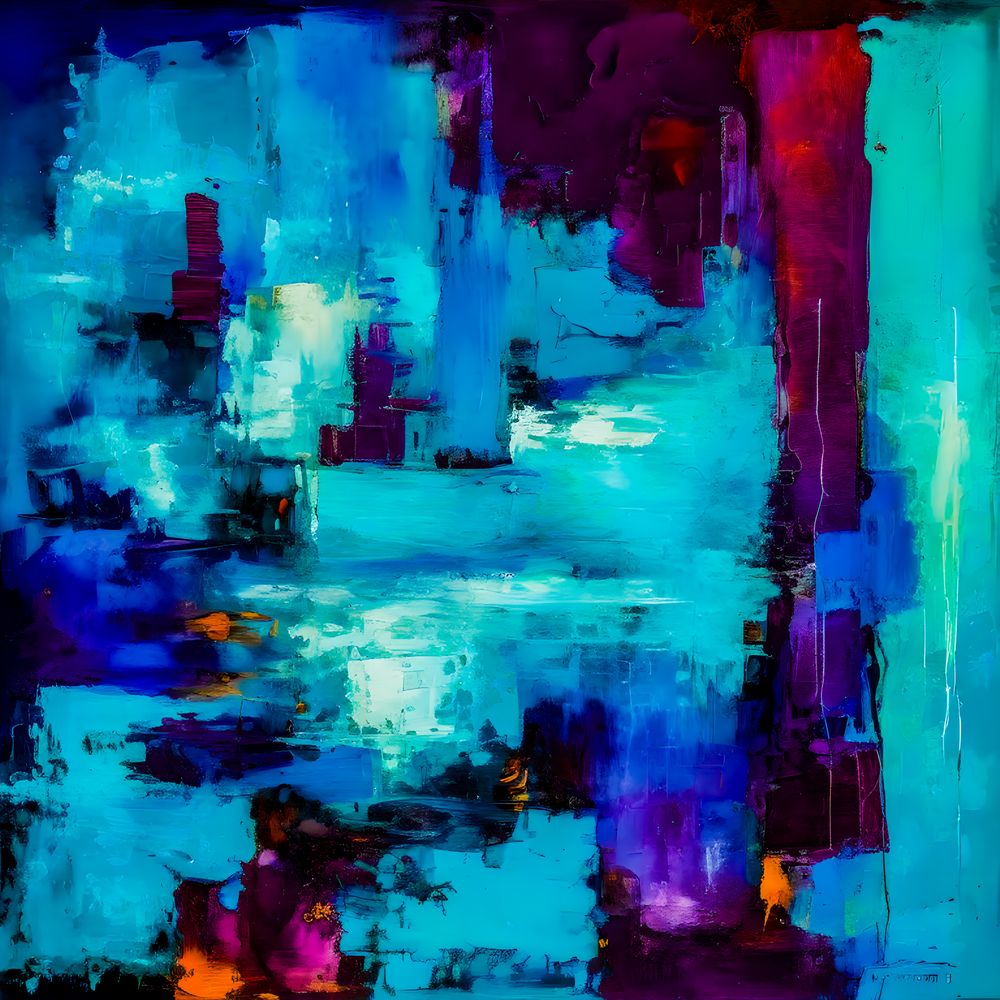
Flowing Dimensions is an abstract visual investigation into the relationship between space, movement, and psychological perception. Through the use of saturated chromatic contrasts, layered textures, and fragmented structural forms, the artwork constructs an environment in which dimensions are experienced as unstable, fluid, and emotionally charged. Rather than depicting a fixed landscape or recognizable architecture, the composition proposes a shifting spatial reality where boundaries dissolve and forms continuously transform. The title itself reinforces this concept by presenting dimensions not as static measurements, but as dynamic states of being.
Formal Analysis
The composition is dominated by an interplay of luminous turquoise and deep blue fields, interrupted by vertical masses of violet, magenta, and crimson. These contrasting tonal areas create both tension and rhythm across the pictorial surface. The cooler tones establish openness, depth, and atmospheric expansion, while the warmer accents punctuate the image with intensity and energetic focus.
Structurally, the painting appears to contain architectural references—pillar-like forms, walls, thresholds, and suspended blocks—yet these elements remain fragmented and unstable. They do not function as literal constructions, but rather as suggestions of built space in transition. The layering of opaque and translucent passages further destabilizes perspective, creating a sense of multiple planes coexisting simultaneously.
Brushwork and texture contribute significantly to the visual language of the piece. Gestural marks, scraped surfaces, and softened edges evoke motion and erosion, suggesting that the image is in a continual state of becoming rather than completion.
Conceptual Interpretation
At its core, Flowing Dimensions explores the idea that space is not neutral or fixed, but deeply connected to emotional and psychological states. The painting can be understood as a metaphor for consciousness itself: layered, shifting, and impossible to contain within singular boundaries. Each zone of color functions as a separate emotional register, while their intersections imply transitions between inner experiences.
The absence of stable perspective encourages the viewer to abandon conventional orientation. Instead of observing a scene, one enters a perceptual field where movement replaces certainty. This reflects contemporary understandings of identity and memory as fluid constructs rather than permanent structures.
Meaning of the Title
The title Flowing Dimensions operates as both poetic statement and conceptual framework. The word “flowing” implies movement, continuity, and transformation. It resists rigidity and suggests organic change. “Dimensions,” by contrast, traditionally refers to measurable aspects of space—height, width, depth, or parallel realms of existence. When combined, these terms create a productive contradiction: measurable space becomes fluid, and fixed reality becomes unstable.
Thus, the title may be interpreted as referring to:
1. The merging of physical and psychological space.
2. The transformation of memory into visual architecture.
3. The coexistence of multiple emotional states within one moment.
4. The rejection of linear, rational systems of perception.
Conclusion
Flowing Dimensions presents abstraction as a means of rethinking how space is experienced. Through color, fragmentation, and layered movement, the artwork challenges conventional ideas of structure and perspective. It proposes that dimensions are not merely external measurements, but internal experiences shaped by emotion, memory, and consciousness. In this sense, the work becomes not only an image, but an immersive field of transition where boundaries dissolve and new forms of perception emerge.
Contract
0xe2d9...11df
Network
Ethereum
Token ID
19
Seller
0xe469...e32e
Artist
Magdalena Kaczmarczyk
