Carl Sagan is one of my personal heroes. The legacy of his incredible book "Cosmos", and his documentary of the same name, was extended with the 2014 "Cosmos: A Spacetime Odyssey", hosted by Neil deGrasse Tyson.
This is the fourth of a 13-piece collection - one per episode of the series. It is my attempt to pay tribute to Sagan, and to spread his humbling influence farther in the world.
Episode 4 is entitled "A Sky Full of Ghosts". It's all about stars and the time it takes for their light to reach our eyes. Through a conversation between William Herschel and his son, it is explained that most of the stars we see at night are much older than they appear. The nearest, only 4 years older, but the very farthest in our galaxy are almost one hundred thousand years older. Thus, many of the oldest stars we see are possibly already dead and the farthest galaxies certainly are.
It also goes into the mystery of black holes, first predicted by the little-known genius John Michell, and how even light is affected by their immense gravity. Further explained is how key scientists built our modern understanding of light and gravity: William Herschel's discovery of infrared radiation, combined with Michael Faraday's work on electromagnetism and James Clerk Maxwell's equations, revealed that light is just one part of a vast electromagnetic spectrum—both visible and invisible. These breakthroughs led to Einstein's revolutionary insights about the speed of light as a cosmic constant and gravity as the warping of space-time.
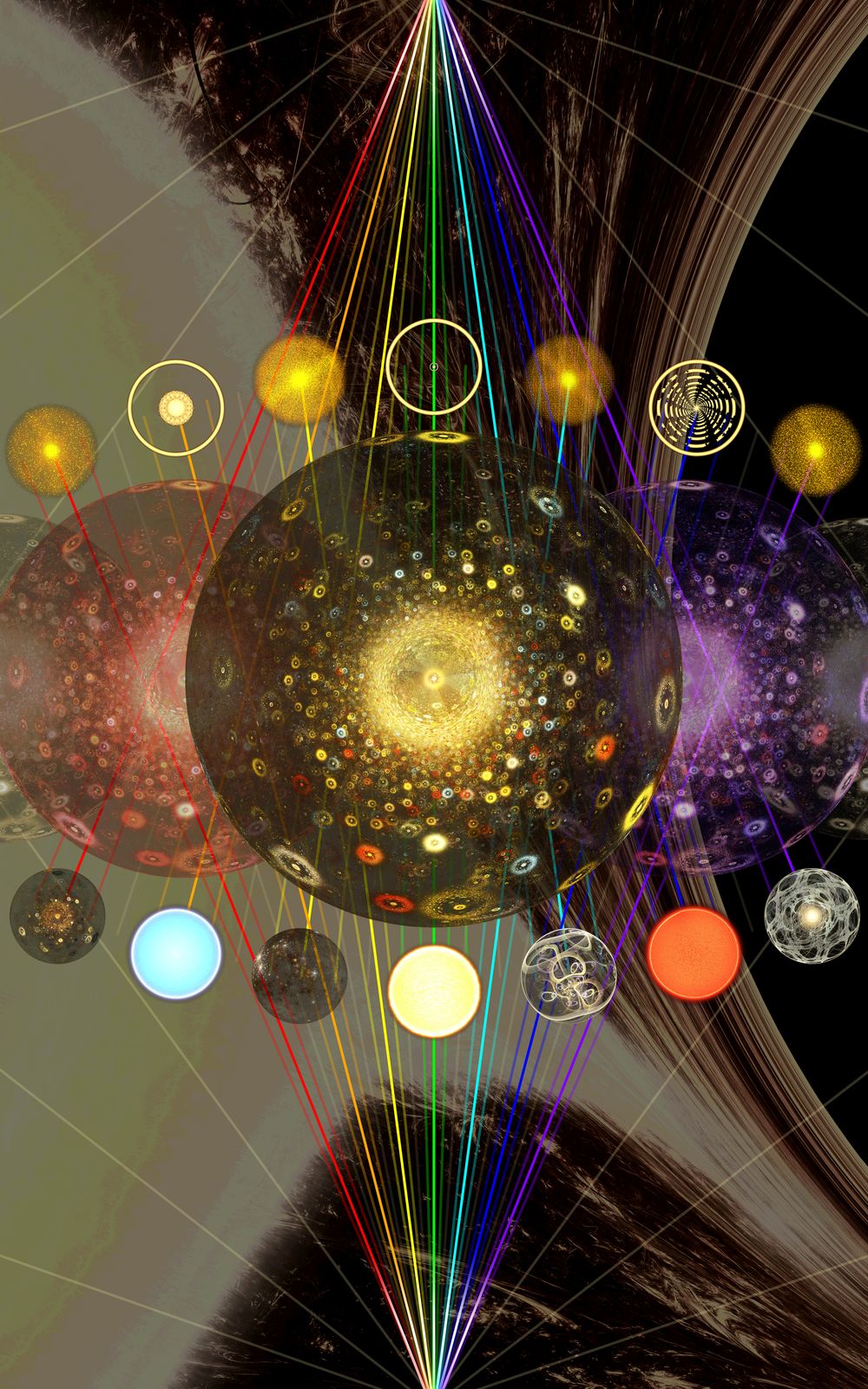
In "Of Time and Light" I wove together symbols of all these concepts and discoveries. The black hole and the star (being consumed by it) in the background form the shape of an hourglass - a literal and metaphorical representation of gravity distorting time. The central 'universe' has red- and blue-shifted copies of itself, finally turning monochromatic, meant to represent both the invisible part of the spectrum and also the 'ghosts' of immensely distant celestial bodies. The prismed light from the center top and bottom also form pendulums, another symbol of time.
The smaller spheres (the pendulums’ weights) depict photons, atoms, stars, galaxies and alternate universes — all of existence at different scales — which put together make the shape of an eye: the observer; that which receives all the light and tries to make sense of it.
Contract
0x881a...2743
Network
Ethereum
Token ID
4
Seller
0x25a7...9042
Artist
Mandelsage
Collection
Cosmos